

MCP Gateway
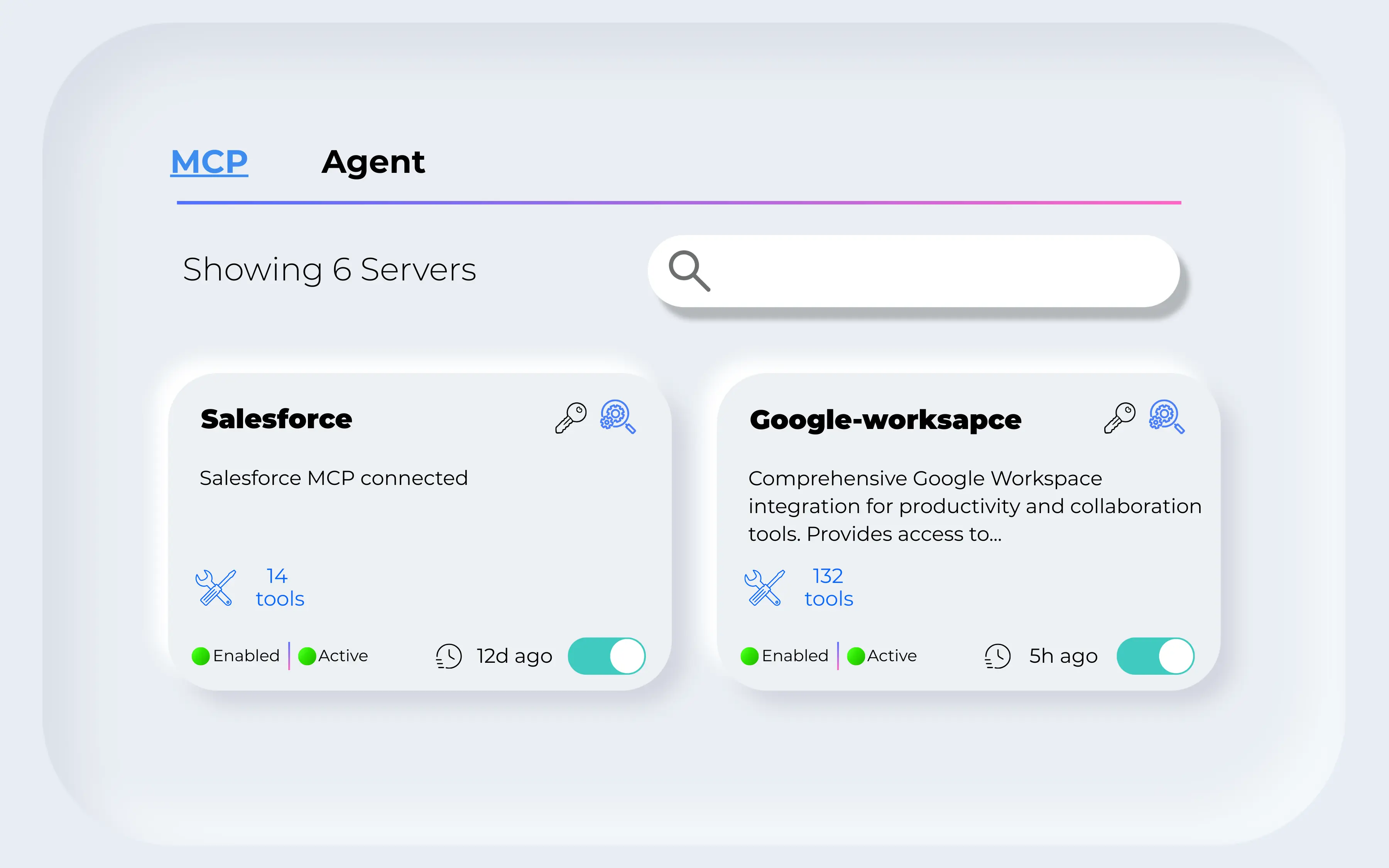
Provides the client-facing endpoint for discovering and invoking permitted MCP servers.
Explore MCP GatewayJarvis is an enterprise MCP gateway and server registry that runs in your AWS or Azure environment to discover, authorize, route, and observe every approved tool call. Connect MCP servers and AI clients through one customer-controlled, policy-enforced endpoint.
Jarvis Registry brings related capabilities together. The MCP server catalog and MCP Gateway work together; agent and skill capabilities have distinct roles.
Provides the client-facing endpoint for discovering and invoking permitted MCP servers.
Explore MCP GatewayCatalogs MCP server endpoints, transports, metadata, and sharing settings as part of Jarvis Registry.
Explore Jarvis RegistryProvides the runtime entry point for governed agent-to-agent interactions.
Explore Agent GatewayCatalogs agent ownership, capabilities, and lifecycle information.
Explore Agent RegistryManages and distributes approved skills as an adjacent Registry capability.
Explore Skill GatewayProvides cross-cutting governance context for identity, privacy, and observability across AI workloads.
Explore Governed AIFive core components work together to make every MCP server in your enterprise discoverable, governed, and ready for any AI client or copilot.
Every registered MCP server and its tools discovered via one endpoint - permission-scoped so each AI client sees exactly what it can invoke.
Federate MCP servers and agents from AWS AgentCore. Azure AI Foundry federation imports agents into the shared registry for review and governed access.
For OAuth-protected MCP servers, Jarvis stores downstream credentials encrypted at rest and can refresh access tokens before forwarding a request. Copilots do not receive raw credentials.
RBAC scopes and resource ACLs control access to registered MCP servers and tools. Federated resources use the registry access model after import.
OpenTelemetry and Prometheus expose platform and MCP activity metrics, including operations and latency, for export to your observability backend.
Everything you need to discover, govern, secure, and observe every MCP server tool call across your enterprise AI stack.
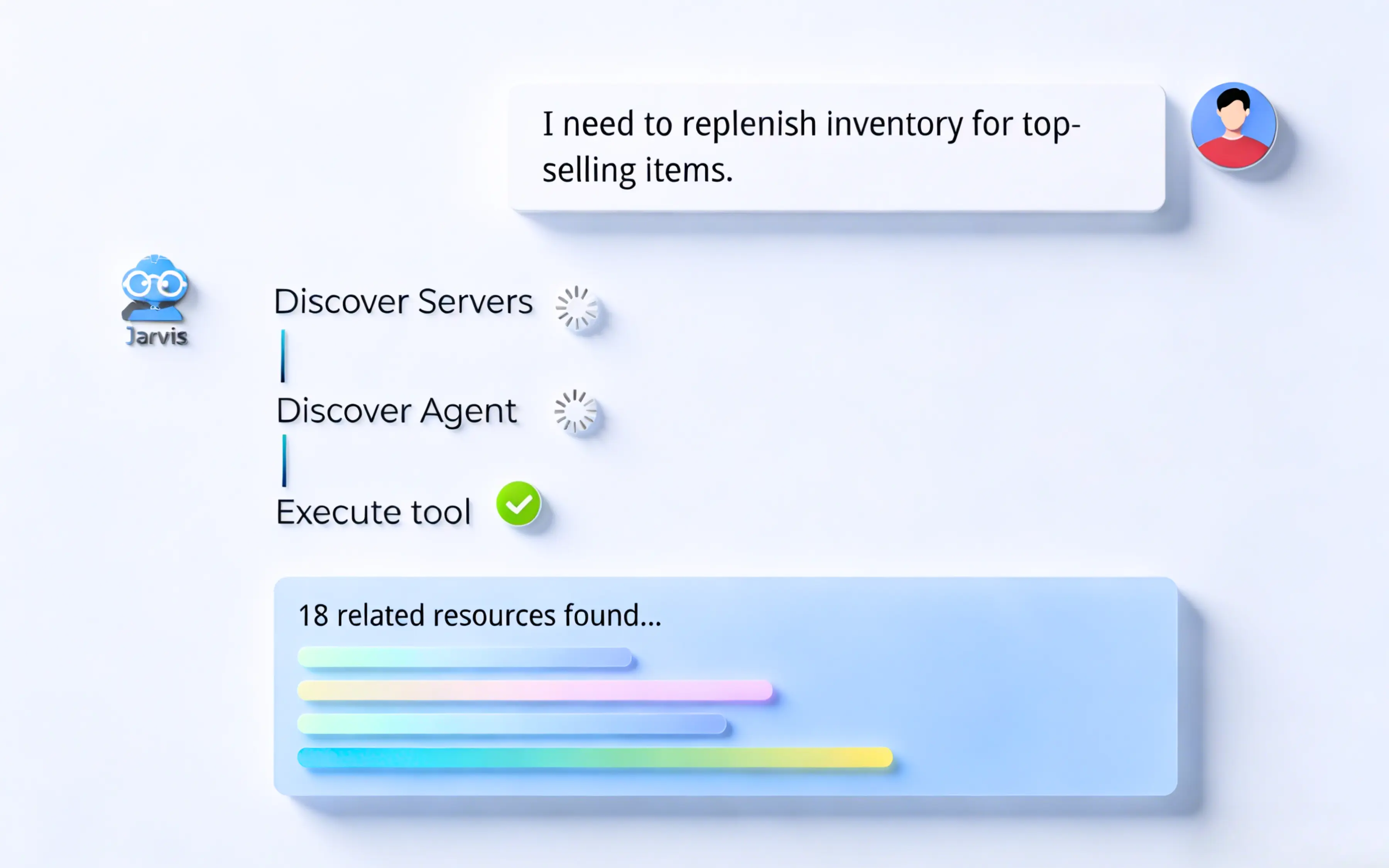
Connect any AI copilot or MCP client to a single authenticated gateway endpoint and get automatic discovery of every registered MCP server and its tools - no per-client configuration, no manual server lists. The MCP registry surfaces only the tools each identity is permitted to invoke, giving every client a permission-scoped view of your entire MCP server catalog.
Define role-based access control scopes and per-tool ACL policies that apply uniformly across every MCP server in the catalog - whether self-hosted, federated from AWS AgentCore, or imported from Azure AI Foundry. The MCP gateway enforces policy on every tool call at the gateway layer, not inside individual MCP servers.
Platform metrics cover registry operations, MCP discovery and execution, server requests, resource access, prompt execution, and latency. Route telemetry through the OpenTelemetry Collector to supported OTLP backends; the published documentation does not specify per-call payload or policy-snapshot logging.
When a downstream MCP server uses OAuth 2.0, Jarvis stores its client and token configuration encrypted at rest, can refresh an expired or near-expiry access token, and keeps raw credentials from the calling copilot.
When users have individual OAuth identities for a downstream service, Jarvis can store per-user credentials and use the invoking user's credential for that service. Stored credentials are encrypted at rest; the documentation does not specify the encryption algorithm.
MCP servers deployed in AWS AgentCore and Azure AI Foundry are imported into the Jarvis MCP registry, governed under your access policies, and exposed through a single MCP gateway endpoint - no redeployment, no duplicated infrastructure.
MCP servers deployed in AWS AgentCore are imported into the Jarvis MCP registry, governed under your access policies, and exposed through a single MCP gateway endpoint - no redeployment, no duplicated infrastructure.
Import Azure AI Foundry agents into Jarvis Registry, then review their visibility and grant access through the registry sharing model.
Jarvis Registry acts as the universal MCP gateway - connecting any AI client to every registered and federated MCP server through one endpoint.


See how Jarvis Registry brings enterprise-grade MCP gateway governance, MCP server registry management, and full observability to your AI stack.
The MCP Gateway provides a single entry point to registered MCP servers, while Jarvis Registry catalogs resources and applies access controls. These documented capabilities describe how it fits an existing estate.
| Concern | Documented behavior |
|---|---|
| Discovery | A single Registry Endpoint exposes the MCP servers the authenticated user is permitted to access. |
| Transports | MCP server registration supports HTTPStreamable and SSE transports. |
| Downstream OAuth | OAuth 2.0 credentials can be stored encrypted at rest and refreshed when an access token expires or nears expiry. The documentation does not specify the encryption algorithm. |
| Access control | RBAC scopes and resource ACLs govern access to MCP servers and tools; resources are private by default until shared. |
| Federation | The AgentCore integration documents importing MCP servers and agents. The Azure AI Foundry integration documents agent import. |
| Observability | OpenTelemetry and Prometheus cover platform operations and MCP activity metrics, including latency. The docs do not specify per-call payload or policy-snapshot logging. |
Last verified: October 9, 2026
The gateway stands or falls on its authorisation model, because it holds credentials for many downstream servers. These rows name every specification involved so that model can be reviewed rather than assumed.
| Specification | Value |
|---|---|
| Protocol | Model Context Protocol (MCP), published November 2024, over JSON-RPC 2.0 |
| Integration surface | 1 endpoint per client instead of 1 integration per MCP server |
| Server redeploys required | 0 — registration is by endpoint, servers keep their runtime |
| Base authorization | OAuth 2.0 (RFC 6749), Bearer usage per RFC 6750 |
| Token scoping | Resource Indicators (RFC 8707) — a token for 1 server is not replayable at another |
| Delegation | OAuth 2.0 Token Exchange (RFC 8693) |
| Public-client flows | PKCE (RFC 7636) |
| Token format | JSON Web Token (RFC 7519), signed per RFC 7515 |
| Auth elicitation | Supported — a tool can request a downstream credential mid-session |
| Identity federation | OpenID Connect Core 1.0 and SAML 2.0 |
| Access model | Per-tool ACL evaluated on every invocation, layered on RBAC roles |
| Transport security | TLS 1.2 minimum, TLS 1.3 preferred (RFC 8446) |
| Telemetry | OpenTelemetry OTLP — call, policy decision, and latency per invocation |
| Denial responses | HTTP 401 unauthenticated, HTTP 403 policy denial, HTTP 429 rate limited |
| Zero-trust reference | NIST SP 800-207 (2020) |
| Runtimes | 3 managed Kubernetes services — Amazon EKS, Azure AKS, Google GKE |
A 3-minute demonstration of what changes when a copilot reaches enterprise context through a governed MCP endpoint rather than a direct per-server integration.
Use the documented deployment and registry workflow to connect clients to approved MCP servers through one endpoint.
Deploy the gateway. The production deployment guide covers an existing Kubernetes cluster on Amazon EKS or Azure AKS.
Register the servers. Add each server URL to the catalog and select its transport and authentication type.
Set access permissions. Use registry scopes and ACL sharing to grant the appropriate users or groups access to each resource.
Configure downstream OAuth when needed. For OAuth-protected servers, configure the provider and scopes; Jarvis documents encrypted credential storage and access-token refresh.
Point clients at one endpoint. Connect MCP-compatible clients to the Registry Endpoint to discover and invoke the resources available to them.
A gateway is where tool sprawl becomes a governed catalog: servers are discovered automatically, then exposed only through explicit policy.
The questions below separate a gateway that fits an existing MCP estate from one that would require rebuilding it.
An MCP registry catalogs server details and access settings. An MCP gateway provides the endpoint clients use to discover and invoke permitted servers.
Jarvis Registry provides the catalog and gateway capabilities together; the MCP server catalog is not a separate product route.
The MCP Server Gateway & Registry documentation lists HTTPStreamable and SSE as supported transports for server registration.
For OAuth-protected servers, the registry stores credentials encrypted at rest and can refresh an expired or near-expiry access token. The calling copilot does not receive the raw downstream credential.
The public documentation does not specify the encryption algorithm.
The observability documentation describes OpenTelemetry and Prometheus metrics for registry, authentication, and MCP activity, including request counts and latency.
It does not specify that every tool call logs its arguments, identity, or policy snapshot.
The MCP Gateway is one part of Jarvis Registry. These pages explain the related registry, gateway, skills, and governance roles.
First-party product documentation for the capabilities described on this page.