

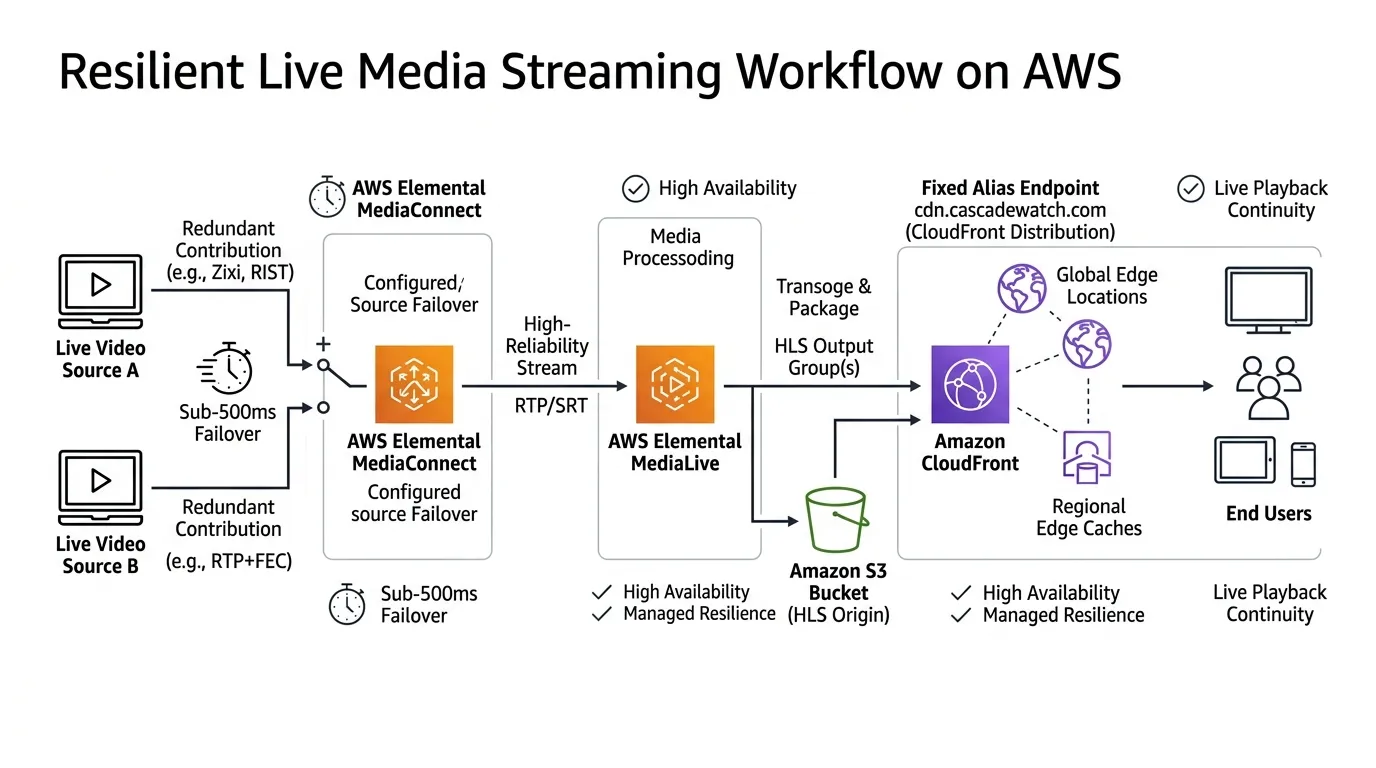
Cascade Watch is a technology startup delivering interactive live-streaming experiences that blend storytelling, gaming, and social engagement for brand audiences. As production demands grew, the platform's 1-path SRT contribution infrastructure lacked the redundancy to protect live sessions from source outages without causing visible viewer interruptions. ASCENDING designed a fully managed resilient media streaming pipeline — using AWS Elemental MediaConnect, MediaLive, and Amazon CloudFront — that triggers automatic source switchover within 500ms and delivers live playback to audiences across 200+ global edge locations.
BackgroundStreaming Startup Modernizing Resilient Media Streaming on AWS
Cascade Watch is a technology startup building the next generation of audience-interactive live video. The platform layers branching narrative, gaming mechanics, and social engagement over live production, creating an experience that goes well beyond traditional broadcast. As the product matured and audience ambitions scaled, Cascade Watch selected AWS Media Services as the cloud foundation for its live delivery infrastructure, specifically for the managed resilience and global scale capabilities the platform provides.
The early streaming environment relied on 1 SRT contribution path from an on-premises raster encoder to a cloud-based processing layer. This 1-path setup served the product through initial development, but a single point of failure at the ingest stage became an unacceptable risk as production demands increased. Any source interruption — a network disruption, encoder reboot, or upstream facility issue — had the potential to cause a full stream drop for active viewers. Cascade Watch needed a resilient media streaming architecture that could absorb input failures automatically and maintain a continuous HLS output without requiring the already-finished client application to change its player logic or fixed CDN endpoint.
The ChallengeSeamless Source Failover Without Disrupting the Client Experience
The challenge is a 4-part constraint involving failover speed, endpoint stability, playback quality, and operational visibility. Cascade Watch needed to increase stream resilience without forcing disruptive rebuilds on a finished product.
- A live stream source outage had to trigger automatic failover in under 1 second — fast enough that viewers would not detect an interruption or see a buffering event.
- Playback quality had to remain stable through any source transition, with 0 visible artifacts or quality drops reaching the viewer.
- The architecture had to integrate with an existing client application that depended on a fixed CloudFront alias endpoint for HLS delivery — a constraint that eliminated CDN migration as an option.
- The delivery infrastructure needed to scale to audience sizes potentially 10x the current baseline without manual capacity provisioning.
- The small engineering team had no real-time visibility into stream health, making incident response slow and reactive.
AWS Advanced Tier Partner with Proven Elemental Media Streaming Experience
ASCENDING is the cloud engineering partner Cascade Watch selected to design and build this resilience upgrade from architecture to production delivery. As an AWS Advanced Tier Services Partner, ASCENDING brought verified delivery experience with AWS Elemental media services and high-availability streaming architectures for production workloads. The team had prior deployments of SRT-based contribution pipelines with automatic source failover, reducing design iteration time and accelerating the path to production by approximately 4–6 weeks compared to in-house experimentation.
ASCENDING also brought operational discipline to the engagement. In addition to the core failover pipeline, the team implemented Lambda-driven cloud notifications and CloudWatch dashboards so the Cascade Watch engineering team gained real-time visibility into every failover event and stream state transition without a third-party monitoring platform.
The SolutionAWS Elemental MediaConnect Auto-Failover with Amazon CloudFront Global Distribution
The solution is a 5-stage, fully managed AWS resilient media streaming pipeline that pairs automatic sub-second source failover with global edge delivery across 200+ CloudFront locations. ASCENDING designed the architecture using native AWS Elemental services end-to-end, with a fixed CDN alias that preserves the existing client integration model with 0 front-end changes required.
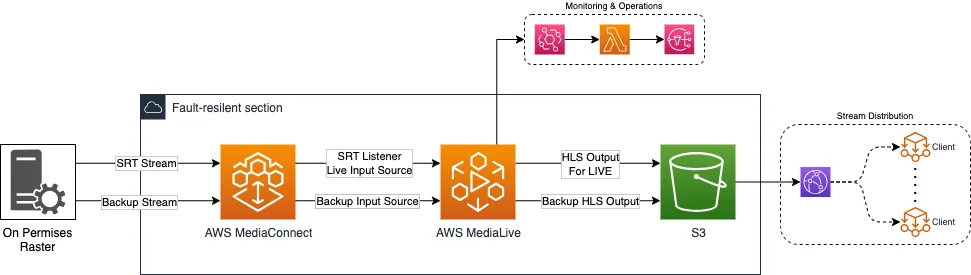
- Dual SRT contribution inputs: 2 identical SRT streams — primary and backup — are ingested from the on-premises raster encoder into AWS Elemental MediaConnect, providing source-level redundancy from the 1st stage of the pipeline.
- Automatic source failover at 500ms: MediaConnect source failover is enabled with a 500ms input-loss detection threshold, triggering an automatic switch to the backup SRT input before the viewer experiences a detectable playback gap.
- MediaLive transcoding and HLS packaging: AWS Elemental MediaLive processes the high-reliability output stream from MediaConnect, transcodes it, and produces HLS output groups for adaptive bitrate delivery — handling encoding and segment packaging in a single managed stage.
- Amazon S3 as HLS segment origin: Packaged HLS segments are written to an Amazon S3 bucket, which serves as the stable origin for the CloudFront distribution. S3 decouples encoding throughput from delivery scaling and provides durable segment storage.
- Amazon CloudFront global edge delivery: Amazon CloudFront routes all viewer HLS playback requests through the fixed alias endpoint —
cdn.cascadewatch.com— distributing traffic across regional edge caches. Because the alias is unchanged, 0 client-side integration updates are required as the backend architecture evolves. - Lambda-based monitoring and alerting: AWS Lambda functions and Amazon CloudWatch events provide real-time notifications on failover triggers and stream health events, giving the engineering team immediate visibility into production incidents.
Sub-500ms Failover and Viewer Continuity Across 200+ Edge Locations
The outcome is a production-grade resilient media streaming platform that absorbs source failures in under 500ms and delivers live content to global audiences without any changes to the Cascade Watch client application or viewer-facing endpoints.
- Eliminated the single-point-of-failure contribution risk by configuring 2 redundant SRT inputs with automatic MediaConnect failover.
- Source failover triggers at the 500ms threshold, keeping live stream continuity intact and preventing mid-session viewer dropout.
- Preserved 100% of the existing client application behavior — the fixed alias endpoint and HLS delivery contract are unchanged.
- Enabled global delivery across 200+ Amazon CloudFront edge locations without any CDN reconfiguration on the client side.
- Deployed a 6-component managed pipeline that scales each stage independently to support significant audience growth.
- Established real-time stream health visibility through Lambda-triggered alerts and Amazon CloudWatch metrics.
Built with AWS Elemental MediaConnect, MediaLive, and Amazon CloudFront
Frequently Asked Questions
How fast does the architecture recover when a live source input fails?
AWS Elemental MediaConnect is configured with 2 SRT inputs — primary and backup — and automatic source failover enabled at a 500ms input-loss threshold. When the primary input drops, MediaConnect detects the failure within that 500ms window and switches to the backup feed automatically, keeping the downstream MediaLive stage and HLS output continuously active. The result is a stream recovery that occurs before a typical viewer perceives a buffering event.
Does deploying this AWS architecture require changes to Cascade Watch's existing client application?
No. Amazon CloudFront continues to route all viewer requests through the existing fixed alias endpoint (cdn.cascadewatch.com), so the client application, HLS player configuration, and viewer URLs all require 0 changes. The backend pipeline — MediaConnect, MediaLive, and S3 — was upgraded entirely behind the existing CloudFront distribution without modifying 1 line of front-end code.
What AWS service handles live video transcoding and packaging in this pipeline?
AWS Elemental MediaLive receives the high-reliability stream output from MediaConnect, transcodes it, and produces HLS output groups for adaptive bitrate delivery. MediaLive is a fully managed broadcast-grade transcoding service that eliminates self-managed encoding infrastructure, handling both bitrate encoding and HLS segment packaging as 1 integrated stage in the pipeline.
How does this architecture scale to support large live audiences without manual intervention?
Amazon CloudFront handles delivery scale automatically, routing playback through 200+ edge locations and regional caches globally. Amazon S3 as the HLS segment origin scales elastically to handle any number of concurrent playback requests without capacity planning. Each of the 4 core managed pipeline stages — MediaConnect, MediaLive, S3, CloudFront — scales independently, meaning audience growth of 10x or more requires no architecture changes or manual provisioning.
What monitoring and alerting does the resilient media streaming pipeline provide for the engineering team?
AWS Lambda functions are configured to emit real-time event notifications whenever the pipeline records a state change — including failover triggers, source health degradation, and output interruptions. Amazon CloudWatch metrics provide time-series visibility into pipeline throughput and error rates. The engineering team receives actionable alerts within seconds of a stream event, reducing mean-time-to-awareness from minutes to under 1 minute.