

The insurance document classifier is a GenAI pipeline ASCENDING built on AWS for the insurance and risk management arm of a financial services company. The company faced manual, per-page review of insurance documents at an incumbent cost of $0.35 per page. ASCENDING replaced that manual process with automated insurance document classification and extraction, cutting processing cost to $0.10 per page — a 71% reduction — in a focused 3-week engagement.
BackgroundManual Insurance Document Review for Loan Servicing Operations
The client is a Financial Services Company that processes several distinct types of insurance policies as part of its insurance and risk management servicing operations. Historically, this document review was manual, with an incumbent cost benchmark of $0.35 per page. The company engaged ASCENDING to determine whether generative AI could handle insurance document classification and extraction faster and at lower cost, without sacrificing the auditability a regulated financial institution requires. ASCENDING delivered the engagement in a focused 3-week timeline
The ChallengeExplainable, Auditable Classification
The challenge is a document-processing workload spanning several distinct insurance document types, arriving in inconsistent formats, that must hold up to compliance scrutiny at every step. Insurance packets are scanned PDFs with variable layouts, multi-column pages, and multi-policy packets, and the client needed a system that could read them accurately, classify them correctly, and extract structured fields from each one — all while remaining explainable enough for financial-services auditors.
- Documents arrive as scanned PDFs with variable layout, multi-column pages, and multi-policy packets, where a single page can list several distinct policies.
- Field extraction has to be scoped precisely per document type, since fields fall into 3 categories — required, optional, and not-required — that differ by policy type, and incorrect fields cannot silently ship.
- Every classification and extraction decision needs a human-readable rationale so reviewers and auditors can verify why the system made a call.
- Low-confidence or incomplete results must route to a human reviewer rather than auto-publish, without re-running — and re-paying for — the whole pipeline.
- The solution needed to beat the existing $0.35-per-page cost benchmark to justify the investment.
AWS Advanced Tier Services Partner with Generative AI Competency
ASCENDING is an AWS Advanced Tier Services Partner with Generative AI Competency, and the implementation partner responsible for the cloud architecture, GenAI pipeline design, and delivery of the solution. ASCENDING brought hands-on experience with Amazon Bedrock and agentic AI delivery, including Amazon Bedrock AgentCore Runtime, to design a tool-calling pipeline architecture rather than a brittle chain of point-to-point integrations, and paired it with deterministic cost metering so the client could verify the economics of every document processed rather than take vendor claims on faith — the kind of financial services document AI accountability regulators expect.
The SolutionServerless AWS Pipeline Orchestrated by Amazon Bedrock AgentCore
The solution is a serverless, AWS-native pipeline that runs each document through Amazon Textract and Amazon Bedrock across a 7-step sequence — ingestion, OCR, classification, extraction, validation, human review, and cost metering — with a secured web review UI standing behind it for human-in-the-loop correction. The diagram below reflects the project's own architecture documentation, including its agent-to-agent handoff framing between processing stages.
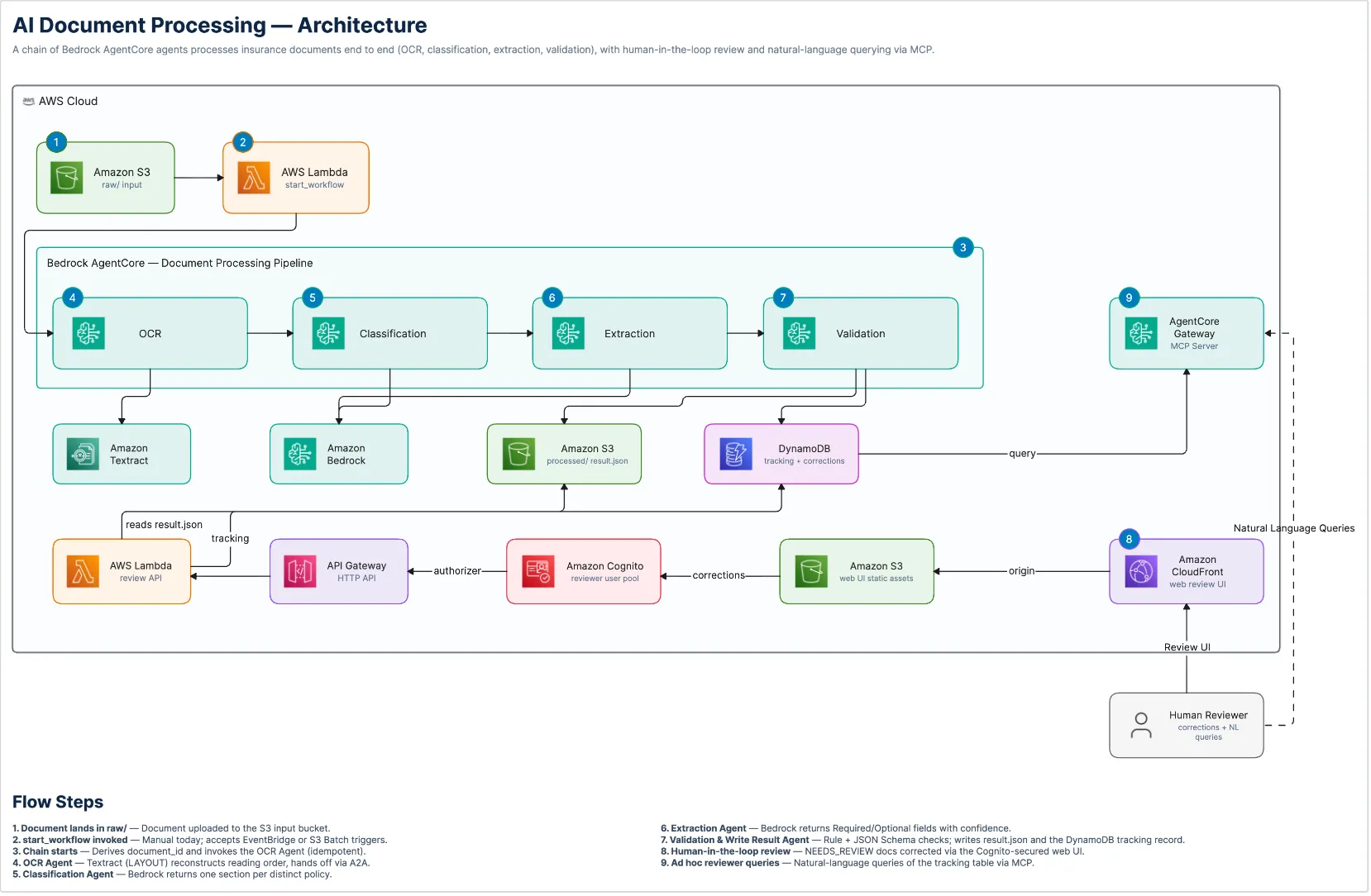
- Ingestion — every incoming document is processed exactly once, even if the same file is retried or resubmitted, so nothing is duplicated or double-billed.
- OCR — Amazon Textract accurately reconstructs reading order across multi-column insurance forms, so classification and extraction start from clean, correctly-ordered text instead of scrambled OCR output.
- Classification — a Bedrock call using Anthropic's Claude Sonnet 4.5 returns 1 section per distinct policy found in the document, grounded with an insurance-domain prompt and validated against a known class set so a hallucinated class can never propagate downstream.
- Extraction — every extracted field comes with a confidence score and a rationale citing the source text — the citation trail auditors need to trust the output without re-checking it by hand.
- Validation — rule-based checks catch missing required fields and low-confidence output before anything ships, so incomplete or unreliable data never slips through unnoticed.
- Human-in-the-loop review — flagged documents route to a secured review UI where a reviewer corrects fields; the original AI output is never overwritten, so there's always a clean audit trail between what the model produced and what a human changed.
- Cost metering — every document accumulates a per-page cost figure, combining Textract and Bedrock token cost, written into its own output record, giving a continuous, verifiable comparison against the $0.35-per-page baseline.
The system is built with strict security defaults throughout — no public access to stored documents, encryption at rest, and least-privilege access scoped to each function — the security posture a regulated financial institution requires. Reviewers can also check on document status through a natural-language chat interface instead of digging through the web UI.
The Outcome71% Lower Document Processing Cost With Built-In Auditability
The outcome is a measurable reduction in per-document processing cost alongside a system built for auditability from day one. Every document's cost is calculated and recorded at the moment it's processed, rather than estimated after the fact, giving the client a continuous, verifiable way to reduce insurance document processing costs across the pipeline.
- Cost per page dropped from a $0.35 baseline to $0.10 — a 71% reduction — verified per-document via built-in cost metering.
- Automated insurance document classification across several distinct insurance document types, covering 1,200+ documents classified to date, with structured field extraction built in for each.
- Every classification and extraction decision carries a human-readable rationale, giving reviewers and auditors a clear trail from source text to extracted value.
- Low-confidence or incomplete documents route automatically to a human reviewer instead of silently shipping incorrect data, with corrections tracked separately from the immutable model output.
AWS GenAI Document Automation with Amazon Bedrock AgentCore
Frequently Asked Questions
How is the cost-per-page figure calculated?
Every document accumulates Textract and Bedrock cost as it flows through the pipeline — a flat per-page charge for OCR and a per-token charge for classification and extraction. The total, divided by page count, is written into the document's own output record rather than estimated after the fact. Across 1,200+ documents processed, that dropped the per-page cost from a $0.35 baseline to $0.10 — a 71% reduction.
What happens when the system isn't confident in a result?
Documents with missing required fields, low classification or extraction confidence, low OCR confidence, or ambiguous classification — across any of the several distinct insurance document types — are flagged for review and routed to a human reviewer through a secured web UI. The original AI output remains immutable, and corrections are layered on top and merged on read.
Is this auditable enough for a regulated financial institution?
Yes. Every classification and extraction across several distinct insurance document types includes a citation-style rationale, all pipeline calls are traced automatically via Amazon Bedrock AgentCore Observability, and outputs are schema-validated before being persisted to storage.
How long did the engagement take to reach these results?
ASCENDING delivered the pipeline in a focused 3-week engagement, from architecture design through a production-ready system.
Can reviewers check on document status without opening the review UI?
Yes. Reviewers can ask natural-language questions about document status through a chat client instead of only using the web UI, via an optional Amazon Bedrock AgentCore Gateway that exposes a read-only MCP tool over the full set of 1,200+ tracked documents.