
The Mammoth Site's data migration is a move from on-premises file storage to secure, cloud-based collaboration on Amazon WorkDocs. The Mammoth Site needed a secure and scalable way to share large research and operational files across distributed teams, visiting scholars, and external collaborators. ASCENDING migrated core data workflows from on-premises storage to Amazon WorkDocs, enabling faster collaboration with lower infrastructure burden.
BackgroundLegacy On-Premises Storage for a Growing Research Organization
The Mammoth Site is a non-profit museum and active paleontological research site that collaborates with scientists and academic stakeholders around the world. Its teams manage extensive fossil, research, and program data while supporting day-to-day operations for staff, students, and researchers.
As data volume increased, the organization relied on a local server and network-attached storage to manage thousands of files. This model created growing operational pressure and limited access flexibility for distributed users.
The ChallengeModernizing Secure Access Without Disrupting Daily Operations
The challenge is modernizing document collaboration and data access for a distributed research organization without disrupting daily operations. Mammoth Site needed to modernize document collaboration and data access without disrupting daily work. The organization had to maintain secure sharing across geographies while handling rapid data growth and limited in-house IT administration.
- Data growth required frequent on-premises server expansion, increasing cost and maintenance overhead.
- Server incidents required third-party support, creating delays and unplanned operational expense.
- External researchers depended on VPN-based access to on-premises files, reducing collaboration speed and usability.
- Migration complexity increased due to non-standard file names, long path structures, and large-file upload constraints.
- Internet bandwidth at the client site limited direct large-scale cloud transfer speed.
AWS Migration Experience for Constrained, High-Volume Transfers
ASCENDING is an AWS Advanced Consulting Partner with hands-on experience migrating large, sensitive datasets out of legacy on-premises environments. ASCENDING brought practical AWS migration experience and an execution model tailored to constrained environments. The team combined cloud architecture expertise with pragmatic file-transfer operations to complete a high-volume migration under real-world limitations.
As an AWS Advanced Consulting Partner and Public Sector Partner, ASCENDING designed a secure collaboration approach that improved accessibility while preserving control over sensitive research and operational content.
The SolutionA Multi-Path Migration to Amazon WorkDocs
The solution is a centralized, cloud-based content platform that replaces on-premises file storage with secure, scalable collaboration. ASCENDING implemented Amazon WorkDocs as the centralized content platform and designed a multi-path migration strategy to move data safely and efficiently from on-premises storage.
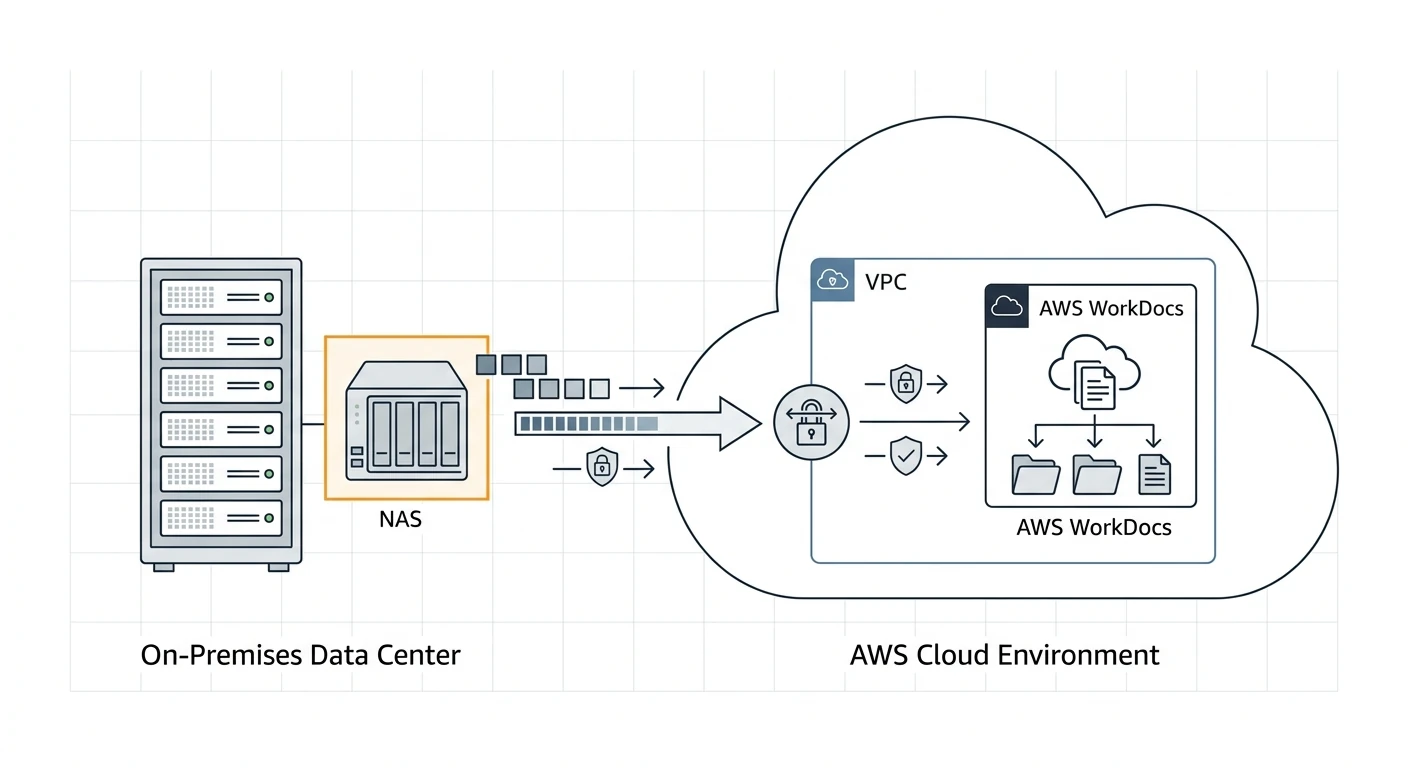
- Assessed source storage footprint (3.55 TB across 58 folders) and mapped folder-level migration sequencing based on file type and size.
- Addressed limited site bandwidth by shipping a 5 TB portable drive for bulk transfer, then uploading through ASCENDING's internal network.
- Used a blended upload method: WorkDocs web uploads for path-sensitive files and WorkDocs Drive synchronization for large-folder throughput.
- Enabled secure role-based access patterns for core staff, scholars, and students, reducing manual access management overhead.
- Preserved familiar desktop workflows while introducing WorkDocs search, synchronization, and collaboration features.
A Scalable, Secure Collaboration Model for Global Research
The outcome is a scalable, cloud-based collaboration model that reduces reliance on physical infrastructure for global research and operations. The Mammoth Site established a more scalable and user-friendly collaboration foundation for global research and operations.
- Eliminated dependence on frequent on-premises storage expansion for day-to-day document collaboration.
- Improved file availability across devices and locations for staff and external collaborators.
- Reduced administrative burden tied to manual permission management and VPN-dependent access.
- Created a resilient operating model for continued data growth in museum, excavation, and education programs.
Built with Amazon WorkDocs Secure Collaboration Services
Frequently Asked Questions
How long does a multi-terabyte on-premises to Amazon WorkDocs migration take?
Timeline depends on data volume, file complexity, and site bandwidth; for The Mammoth Site's 3.55 TB, 58-folder migration, ASCENDING combined a physical drive transfer with staged uploads to move data efficiently despite limited on-site internet bandwidth.
How is data protected during and after a migration like this?
Security is maintained through encrypted cloud storage, role-based access controls, and a cloud architecture reviewed against the AWS Well-Architected Framework, reducing dependence on VPN-based perimeter access.
Can external researchers and scholars still access files securely without a VPN?
Yes. Authorized staff, scholars, and students can securely access and share files from any device or location through WorkDocs' web and desktop clients, removing the need for the VPN-based access required under the previous on-premises setup.