

Maples Rugs is a home furnishings business whose internal sales team relies on a catalog of roughly 60,000 rug pattern images to find and recommend products. There was no existing search tool, so finding a rug pattern meant browsing raw image files by hand with no way to query by style, color, or description. ASCENDING built a GenAI vision pipeline on AWS that automatically describes every rug image, enriches it with existing catalog metadata, and unlocks AI-powered product search through ASCENDING's Jarvis platform — processing 26,572 images across 15+ years of inventory in a 3-week engagement.
BackgroundSemantic Search for a 60,000-Image Rug Catalog
Maples Rugs is a rug manufacturing and distribution company whose sales team needed a faster way to find the right pattern in a catalog of roughly 60,000 images stored in Amazon S3 with inconsistent, often-missing structured metadata. There was no existing search tool — finding a rug pattern meant browsing raw image files by hand, with no way to query by style, color, or description. Maples Rugs engaged ASCENDING to build an agentic pipeline from the ground up: generate consistent, structured descriptions for the catalog with a vision model, combine them with existing product metadata, and expose the result through AI-powered product search for their internal sales team spread across multiple locations. ASCENDING delivered the engagement over 3 weeks.
The ChallengeStructuring an Inconsistent Catalog for Reliable Search
The challenge is a large, inconsistently documented image catalog that needed machine-generated structure before it could be searched reliably, plus a search experience that had to return the same answer to the same question every time.
- No reliable link existed between image filenames and any external product database, so a rug pattern's year, color, or product name couldn't be trusted without manual lookup.
- The catalog mixed real, sellable rug patterns with non-product files — texture swatches, reference images, dimension-variant duplicates — with no reliable way to tell them apart from filenames alone, risking a search tool that surfaced unsellable images to customers as if they were real inventory.
- The team needed to evaluate 2 vision models on description quality, field consistency, and cost before committing the full catalog, since a wrong early choice would mean re-processing tens of thousands of images and re-doing weeks of work.
- Search results needed to be consistent and repeatable — the same natural-language query issued at different times had to return the same ranked results, or sales reps would lose trust in the tool and fall back to manually browsing files.
AWS Advanced Tier Services Partner with Jarvis Chat
ASCENDING is an AWS Advanced Tier Services Partner and the implementation partner responsible for the vision pipeline architecture, model evaluation, and delivery of the search experience. ASCENDING brought hands-on Amazon Bedrock and agentic AI delivery experience to build a production-ready image processing pipeline, and was able to offer Maples Rugs a direct choice between a managed AWS-native option (Amazon Bedrock Knowledge Base) and ASCENDING's own governed Jarvis chat platform — which already let reps upload a photo of a rug to find matching patterns, at no extra development cost or time.
The SolutionA 2-Stage Bedrock Vision and Retrieval Pipeline
The solution is a 2-stage AWS pipeline: an offline batch process that turns raw rug images into structured, validated descriptions, and a search layer that delivers Amazon Bedrock image catalog search through natural language.
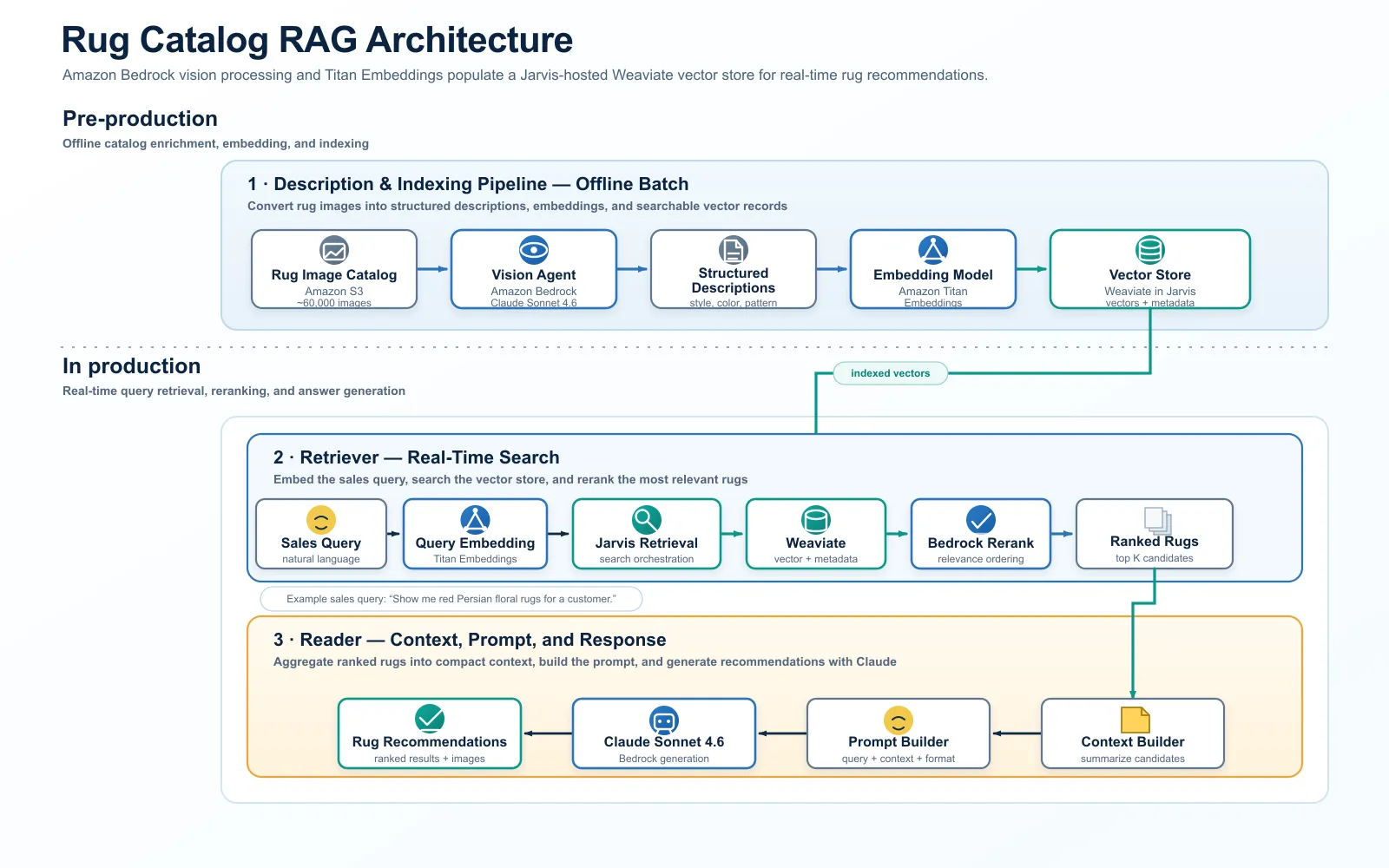
- Ingestion and metadata-based filtering — filename and catalog-metadata rules automatically exclude known non-product images (texture swatches, duplicates, reference shots), narrowing the raw ~60,000-image catalog down to a validated set of roughly 26,793 sellable rug patterns before any vision processing runs.
- Vision description — every image gets a structured, schema-validated description covering pattern type, style, colors, design elements, tone, and complexity — AI-generated product descriptions that stay consistent regardless of how inconsistent the source data was. Claude Sonnet 4.6 and Amazon Nova Pro were run head-to-head on the same image set, and Claude Sonnet 4.6 was selected for production.
- Vector Indexing — validated records are embedded with Amazon Titan Embeddings and written into a vector store. The team evaluated a managed Amazon Bedrock Knowledge Base against ASCENDING's own Jarvis platform, backed by Weaviate, in parallel before selecting Jarvis for delivery.
- Search — where available, the AI-generated description is enriched with existing catalog metadata, such as authoritative year, human-readable color name, and customer-facing product names, replacing fields the vision model alone could only guess at; images without metadata coverage are still indexed on AI-generated fields alone. The sales team then queries the enriched catalog in natural language, such as "Persian floral with red tones," through Jarvis. Jarvis ranks results by vector similarity, filters by structured metadata like style, year, or origin, and reranks a wider candidate set with an Amazon Bedrock reranking model before returning the final results — with image-upload-based visual similarity search built in as well.
26,572 Rug Images Made Instantly Searchable
The outcome is a searchable catalog spanning 15+ years of inventory and 57 distinct rug styles, built from AI-generated descriptions and verified against the pipeline's own run artifacts rather than estimated.
- 26,572 rug images were processed end-to-end and written as structured, validated descriptions, covering 15+ years of inventory across 57 distinct rug styles, unlocking AI-powered product search across the full catalog.
- The pipeline completed at a 99.2% success rate, with the remaining failures logged individually for targeted retry rather than blocking the batch.
- 28,924 records were indexed into the vector store, giving the sales team a searchable catalog built from consistent, schema-validated descriptions instead of raw, inconsistent filenames.
- Claude Sonnet 4.6 and Amazon Nova Pro were run head-to-head against the same image set so the choice could be based on real description-quality and cost data, not vendor claims — Claude Sonnet 4.6 was selected for production.
- Jarvis was selected as the delivered search interface, giving the sales team natural-language search plus image-upload-based visual similarity out of the box — fast and reliably available to reps across every location.
Built with Amazon Bedrock and the Jarvis AI Platform
Frequently Asked Questions
How was search consistency validated?
Results were checked against a defined set of test queries covering common patterns, such as style name, year, and pattern type, to confirm the same query returns the same ranked results across repeated runs — validated across all 26,572 indexed images, a direct requirement from the client's use cases.
Can the sales team search by uploading a photo instead of typing a description?
Yes. Because the delivered interface is Jarvis, image-upload-based visual similarity search comes built in alongside natural-language product search — a rep can upload a photo of a rug and get visually similar catalog matches.
How does existing catalog metadata factor into the pipeline?
Metadata does double duty. Filename and catalog-metadata rules filter the raw ~60,000-image catalog down to a validated set of roughly 26,793 sellable rug patterns before any vision processing runs, and afterward, existing catalog fields like year, color name, and product names enrich the AI-generated description wherever a match exists, replacing fields the vision model alone could only guess at. Images without metadata coverage are still indexed, on AI-generated fields alone.
Does the search use reranking to improve result quality?
Yes. Jarvis's retrieval layer pulls a larger candidate set from the 28,924 indexed records via vector similarity, then reranks that set with an Amazon Bedrock reranking model before returning the final ranked results — a second relevance pass on top of raw similarity search.
Why were 2 different vision models evaluated instead of picking one upfront?
Claude Sonnet 4.6 and Amazon Nova Pro were run against the same image set so the choice could be based on real description-quality and cost data rather than assumption. Claude Sonnet 4.6 was selected for production.