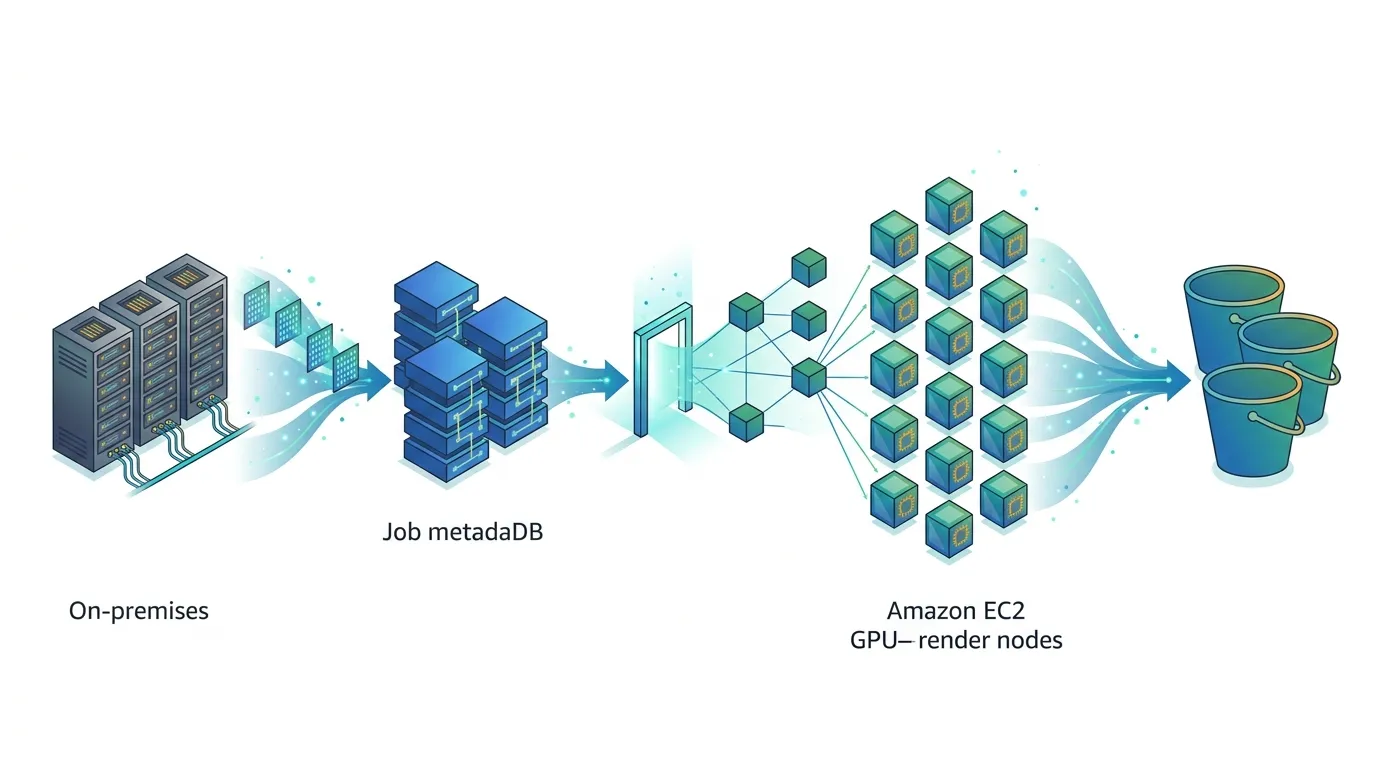
We Are Royale is a creative production agency whose Thinkbox Deadline render farm needed cloud-based elasticity without disrupting artist workflows. We Are Royale's rendering pipeline was tied to physical servers that couldn't flex with production demand. ASCENDING migrated the agency's Thinkbox rendering workload from on-premises infrastructure to a scalable, secure AWS environment built on 10 AWS services — from EC2 GPU Auto Scaling to AES-256 encryption — giving WAR cloud-based rendering capacity without disrupting the on-premises workflow its digital artists relied on.
BackgroundA Creative Agency Rendering on On-Premises Hardware
We Are Royale (WAR) is a renowned creative agency known for its innovative work with clients including Riot Games, Sony Entertainment, Pokémon, and Acura. WAR sought to migrate its Amazon Thinkbox Deadline rendering workload from on-premises infrastructure to AWS, with the primary goals of enhancing scalability, improving performance, and reducing the operational cost of maintaining physical servers.
The ChallengeScaling GPU Rendering Beyond On-Premises Server Capacity
The challenge is an on-premises rendering setup that couldn't flex with fluctuating production and client-deadline pressure. WAR's on-premises rendering infrastructure was constraining both its production capacity and its cost structure.
- Scalability: WAR needed a solution that could dynamically scale resources to handle varying workloads, particularly during peak rendering times.
- Performance: Ensuring high performance and low latency for rendering tasks was critical to meet client deadlines and maintain quality standards.
- Cost efficiency: The agency aimed to reduce total cost of ownership by eliminating the need for frequent hardware upgrades and maintenance.
- Security: Protecting sensitive client data and ensuring compliance with industry standards were top priorities.
An AWS Advanced Consulting Partner for Media and Entertainment
ASCENDING is an AWS Advanced Consulting Partner with hands-on experience running secure, scalable rendering workloads for media and entertainment clients. WAR selected ASCENDING for its extensive experience designing secure, scalable, and cost-efficient AWS solutions. As an AWS Advanced Consulting Partner with a proven track record and a comprehensive approach to assessment and implementation for Media and Entertainment customers, ASCENDING gave WAR confidence that the project would be handled professionally and efficiently.
The SolutionBurst Rendering to AWS with Thinkbox Deadline and EC2 GPU Instances
The solution is a burst-rendering architecture that lets WAR's on-premises Thinkbox Deadline pipeline overflow into AWS on demand. ASCENDING's engagement extended WAR's rendering environment to the cloud, then layered in the infrastructure improvements needed to make that environment scalable, secure, and cost-efficient.
Extend to Cloud: Migration Readiness Assessment and Overflow Rendering
- ASCENDING conducted a detailed Migration Readiness Assessment (MRA) to evaluate WAR's current infrastructure and identify potential challenges, including collecting server data, right-sizing servers, and building a Total Cost of Ownership (TCO) analysis.
- ASCENDING adopted a non-disruptive migration strategy that let digital artists keep their on-premises environment for ongoing rendering work.
- To optimize performance and cost efficiency, ASCENDING introduced an overflow solution that seamlessly shifted large-scale rendering tasks to the cloud, ensuring project deadlines were met without compromising workflow continuity.
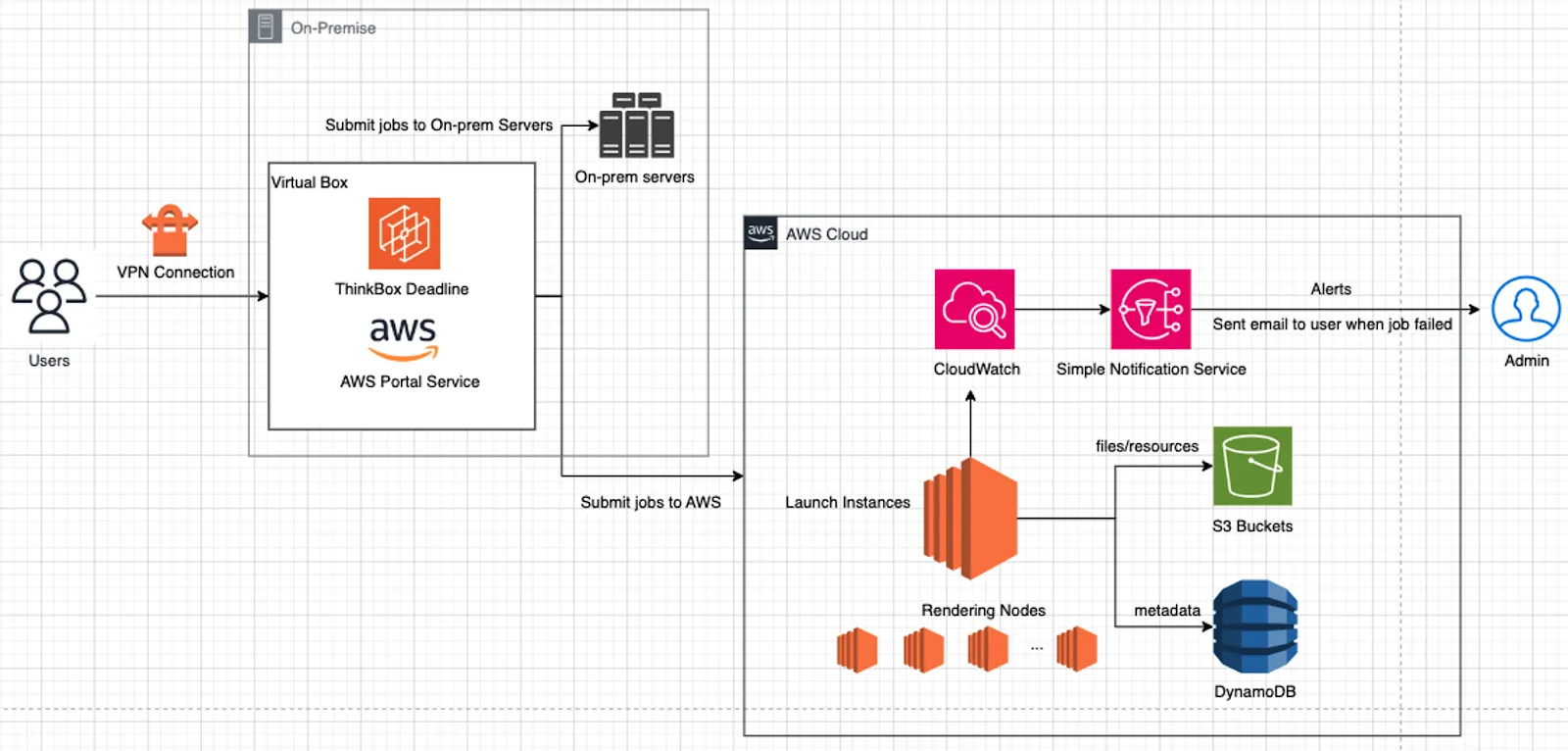
- Users connect over a VPN to on-premises Thinkbox Deadline and AWS Portal Service running in a virtual box, submitting jobs to on-prem servers as before.
- When jobs are submitted to AWS, EC2 rendering node instances are launched on demand to process the overflow workload.
- Rendering nodes write output files and resources to Amazon S3 and job metadata to Amazon DynamoDB.
- Amazon CloudWatch monitors the rendering jobs and triggers Amazon SNS to email the admin whenever a job fails.
Infrastructure Improvement: EC2 GPU Auto Scaling, S3, EBS, EFS, and AWS KMS
- Compute resources: AWS EC2 instances, including GPU instances for rendering tasks, with auto-scaling groups to handle varying loads.
- Storage solutions: Amazon S3 for scalable object storage, Amazon EBS for high-performance block storage, and Amazon EFS for shared file storage.
- Networking: VPCs, security groups, and Network ACLs configured for secure and efficient network management.
- Data encryption: AWS KMS employed for data encryption at rest and in transit.
- Right-sizing and pricing models: Cost-optimized instance types and pricing models, such as Savings Plans and Reserved Instances, recommended based on utilization patterns.
Elastic Render Capacity at a Lower Total Cost of Ownership
The outcome is an elastic, AWS-based rendering environment that scales with production demand while lowering total cost of ownership. The migration gave WAR a rendering environment that scales with production demand while cutting the cost and overhead of managing physical servers.
- Enhanced scalability: WAR now benefits from a highly scalable environment that can efficiently handle peak rendering loads without compromising performance.
- Improved performance: The optimized infrastructure significantly reduced rendering times, enhancing overall operational efficiency.
- Cost efficiency: Migrating to AWS led to substantial cost savings by eliminating the need for frequent hardware upgrades and reducing maintenance costs.
- Security and compliance: Robust security measures ensured the protection of sensitive client data and compliance with industry standards.
Built with AWS Rendering and Cloud Migration Services
Frequently Asked Questions
How long does a Thinkbox Deadline render farm migration to AWS take?
Timeline is a phased rollout that starts with a Migration Readiness Assessment and TCO analysis — right-sizing across 3 dimensions of compute, storage, and networking — then introduces overflow rendering to AWS while artists keep working in their existing on-premises environment throughout the transition. Thinkbox Deadline supports 80+ content-creation applications, so the same overflow pattern extends beyond 3ds Max and V-Ray as WAR's pipeline evolves.
How is client render data protected when jobs burst to AWS?
Security is enforced through VPN-connected access, VPC network controls with security groups and NACLs, and AWS KMS encryption — AES-256 at rest and TLS 1.2+ in transit — so overflow rendering doesn't loosen the protections WAR already applied on-premises.
How does the AWS environment control costs while still scaling for peak rendering demand?
Cost control comes from auto-scaling GPU instances up only when overflow jobs arrive, combined with right-sized instance types and pricing models like Savings Plans and Reserved Instances recommended from actual utilization patterns.
What AWS services back the burst-rendering environment?
10 AWS services cover compute through alerting: EC2 GPU instances in Auto Scaling groups, Amazon S3 — designed for 99.999999999% (11 nines) object durability — Amazon EBS and EFS storage tiers, VPC network isolation, AWS KMS with AES-256 encryption, CloudWatch monitoring, SNS failure alerting, and DynamoDB job metadata. Compute Savings Plans, which can reduce costs up to 66% versus on-demand pricing, keep burst capacity affordable against actual utilization.