
YAGroup is an architecture and design firm whose visualization engineers depend on photorealistic 3D rendering to deliver client projects nationwide. Young & Associates (YAGroup), an architecture and design firm with a nationwide team of visualization engineers, relied on an aging, hands-on on-premise render farm to turn out photorealistic 3D renders for client projects. ASCENDING partnered with YAGroup to migrate that rendering workload to AWS Deadline Cloud, giving designers elastic, on-demand render capacity — and cutting render-farm hardware investment by 70% — without the burden of managing physical machines.
BackgroundAn On-Premise Render Farm for 3ds Max and V-Ray
YAGroup is a design firm whose rendering pipeline now runs on AWS Deadline Cloud after years of relying on an in-house, on-premise render farm. YAGroup's design team works primarily in Autodesk 3ds Max with Chaos V-Ray for photorealistic rendering, producing visualizations for architectural and design projects. Historically, rendering ran on an on-premise farm managed through Deadline Worker and RPManager, with designers directly responsible for adding, removing, and troubleshooting render machines.
That model gave the team flexibility, but it also meant every capacity change or hardware issue landed on the designers themselves rather than on dedicated infrastructure staff, a growing burden as project volume and rendering complexity increased. YAGroup leadership, including team lead Daniel Simacek, engaged ASCENDING to plan and execute a move to a cloud-based rendering pipeline that could scale with demand and reduce the operational load on design staff.
The ChallengeMigrating a Live Render Farm Without Disruption
The challenge is migrating a live, production-critical render farm to the cloud without disrupting active design work. Moving a live, production-critical render farm to the cloud without disrupting active design work required careful planning across infrastructure, workflow, licensing, and cost management.
- Zero-disruption cutover: Designers needed to keep submitting and completing render jobs throughout migration, with no interruption to active projects.
- Elastic capacity without cost overruns: Peak workloads required scaling up to match on-premise capacity (8+ render nodes), while idle periods needed to scale back down to avoid paying for unused compute.
- Tight integration with existing tools: The solution had to work with YAGroup's existing 3ds Max/V-Ray pipeline and their Egnyte network file share, which designers rely on to access and retrieve project assets.
- Operational handover: YAGroup needed a support model and documented playbook so their team (and ASCENDING's support engineers) could troubleshoot rendering issues, from failed jobs to license checkouts to network drive mount failures, without deep AWS expertise.
- Cost visibility: Leadership needed clear, predictable cost modeling before committing to a full production cutover.
Phased AWS Deadline Cloud Migration Expertise
ASCENDING is an AWS Advanced Tier Services Partner with a structured, phased methodology for render farm workloads. ASCENDING brought hands-on AWS Deadline Cloud migration expertise and a phased methodology tailored to render farm workloads, where cloud infrastructure design must account for 3D rendering realities such as licensing, worker scaling, and asset syncing.
Rather than a disruptive lift-and-shift, ASCENDING recommended a rehosting strategy: stand up Deadline Cloud alongside the existing on-premise farm, let designers transition gradually, and only disable on-premise access once the cloud environment was fully validated. This approach reduced risk while giving ASCENDING time to fine-tune scaling, licensing, and network configurations against real production jobs. ASCENDING also used AWS Migration Hub Application Discovery Agent up front to gather real on-premise infrastructure utilization data, ensuring farm sizing and TCO estimates were grounded in observed usage rather than assumptions.
The SolutionAn Event-Driven, Auto-Scaling AWS Deadline Cloud Architecture
The solution is an event-driven, auto-scaling rendering architecture built on AWS Deadline Cloud. ASCENDING designed and deployed an event-driven, auto-scaling rendering architecture that mirrors YAGroup's existing workflow while removing the manual overhead of managing physical render nodes.
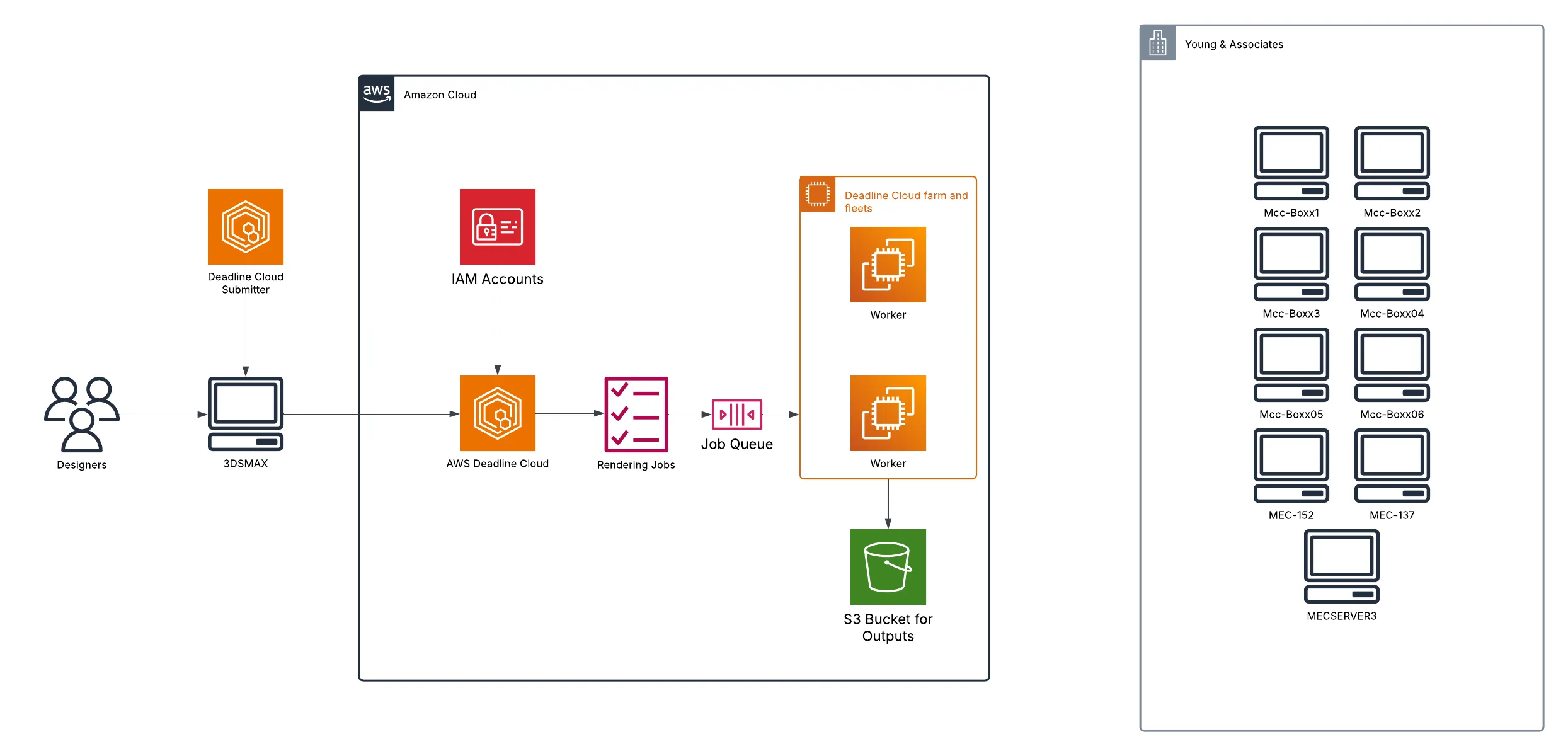
- Assessment and sizing: Used AWS Migration Hub Application Discovery Agent to capture on-premise infrastructure utilization, informing a right-sized AWS Deadline Cloud environment (targeting 42 vCPUs / 90GB RAM peak capacity and 4TB of S3 storage).
- Environment setup: Stood up a Deadline Cloud farm with IAM roles, security groups, cost controls (AWS Budgets and Cost Explorer), and an S3-backed storage layer for render assets and output.
- Event-driven scaling pipeline: Configured the Deadline Cloud queue to trigger an Amazon EventBridge rule whenever jobs arrive, invoking a Lambda function that sets the desired capacity of an EC2 Auto Scaling Group and dynamically launches worker instances from a custom AMI (deadline-fresh-image-v7) only when needed.
- Rendering plugin integration: Deployed the AWS Deadline Cloud submitter for 3ds Max so designers submit jobs the same way they always have, with V-Ray license checkout handled automatically through a dedicated license server instance.
- Asset and file integration: Built a MountNetworkDrive queue environment script so every worker automatically mounts YAGroup's Egnyte network share on boot, keeping the cloud pipeline consistent with designers' existing local-drive workflow; completed renders sync from S3 back to Egnyte for designers to retrieve.
- Testing and validation: Ran hybrid on-prem/cloud workflows in parallel, load-tested job queues, validated failover and recovery, and confirmed rendered output landed correctly in S3 before cutover.
- Cutover and rollback readiness: Executed a staged cutover by redirecting job submissions to the cloud, then disabling on-premise farm access, with a documented rollback plan in case critical issues emerged.
- Post-migration support and playbook: Delivered a 3-day hypercare support window plus a documented operational playbook (job-log debugging sequence, AMI update process, and a real-world example of diagnosing a failed network-drive mount) so YAGroup and ASCENDING support teams can maintain the environment going forward.
Elastic Rendering Capacity with Lower Operational Overhead
The outcome is a fully elastic, cloud-native rendering pipeline that scales automatically with demand. YAGroup now runs its rendering pipeline on a fully elastic, cloud-native foundation that scales automatically with demand and removes the day-to-day burden of physical render farm management from its design team.
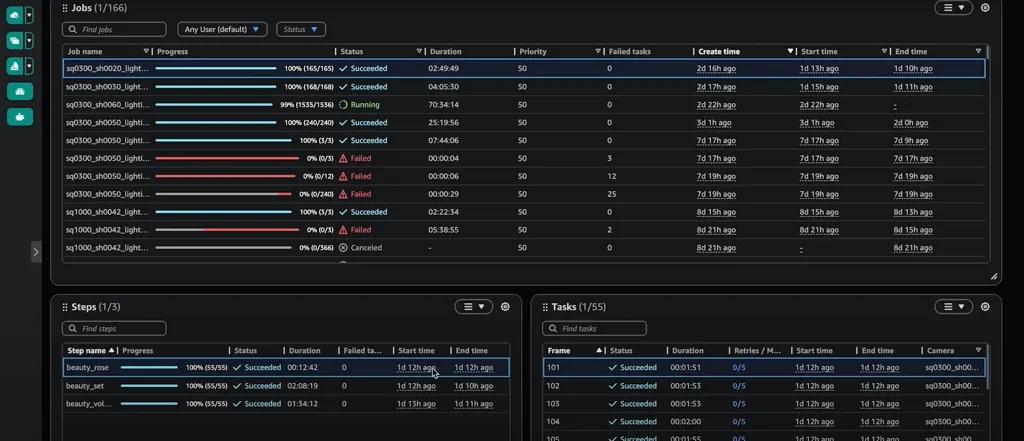
- Elastic, event-driven scaling: Render capacity now scales from a single worker up to 8+ instances automatically based on queue depth, matching prior on-premise peak capacity without manual intervention.
- Predictable, modeled cloud costs: TCO planning showed an estimated $6,091-$10,000/month depending on utilization (20 vs. 40 hours/week), giving leadership clear cost visibility ahead of go-live.
- Unchanged designer workflow: The AWS Deadline Cloud submitter for 3ds Max and automated Egnyte network drive mounting preserved the team's existing submission and file-retrieval process, minimizing retraining.
- Documented, repeatable operations: A support playbook, including a real debugging walkthrough for a failed render output caused by a network drive credential change, equips YAGroup and ASCENDING support engineers to troubleshoot confidently.
- Risk-managed cutover: The rehosting approach allowed on-premise and cloud environments to run in parallel during transition, with a documented rollback plan reducing migration risk.
Built with AWS Deadline Cloud and Elastic Rendering Infrastructure
Frequently Asked Questions
How long does a render farm migration to AWS Deadline Cloud take?
Timeline is a phased rehosting process that runs the cloud environment alongside the existing on-premise farm, letting designers migrate gradually before the legacy environment is disabled — typically spanning assessment, environment setup, parallel validation, and a staged cutover.
Does switching to AWS Deadline Cloud change how designers submit render jobs?
Workflow continuity is a priority in this kind of migration; the Deadline Cloud submitter for 3ds Max preserves designers' existing job-submission process, and license checkout for tools like Chaos V-Ray is handled automatically in the background.
How is rendering cost controlled once capacity scales automatically?
Cost control is achieved through an event-driven Auto Scaling Group that launches worker instances only when jobs are queued and scales back down when idle, paired with AWS Budgets, Cost Explorer, and AWS Deadline Cloud's pay-as-you-go pricing model to keep spend aligned with actual usage.
What happens to on-premise infrastructure and file storage during the transition?
Migration risk is minimized by running the on-premise and cloud environments in parallel, syncing completed renders between Amazon S3 and the existing Egnyte network share, and keeping a documented rollback plan available until the cloud environment is fully validated.
What capacity and cost did the TCO analysis model?
Sizing targeted 42 vCPUs and 90 GB of RAM at peak render capacity with 4 TB of Amazon S3 storage, scaling from 1 worker up to 8+ instances on queue demand. Modeled costs ranged from $6,091 to $10,000 per month at 20 versus 40 hours of weekly rendering, and cutover included a 3-day hypercare support window with a documented operational playbook.