

Jarvis AI
Cloud Services
Talent Solutions
Public Sector
About
Contact Us
image
Frequently Asked Questions

Everything you need to know
about the Agent Gateway

Answers to the most common questions about agent registration, multi-cloud federation, agentic orchestration, security, and observability. Can't find what you're looking for? Schedule a call.

Overview

About the Agent Gateway

An agent registry is the authoritative catalog where AI agents are registered, described by their skills and capabilities, and exposed through a secure, governed gateway. It is the directory service for your agentic infrastructure — what DNS does for hostnames, the agent registry does for AI agents.

Without a central registry, agents proliferate as shadow AI across teams and clouds with no visibility into who can use them, what they can do, or whether they are safe to invoke. Jarvis Registry solves this with 1 governed catalog spanning 3 agent sources: self-hosted, AWS-federated, and Azure-federated.
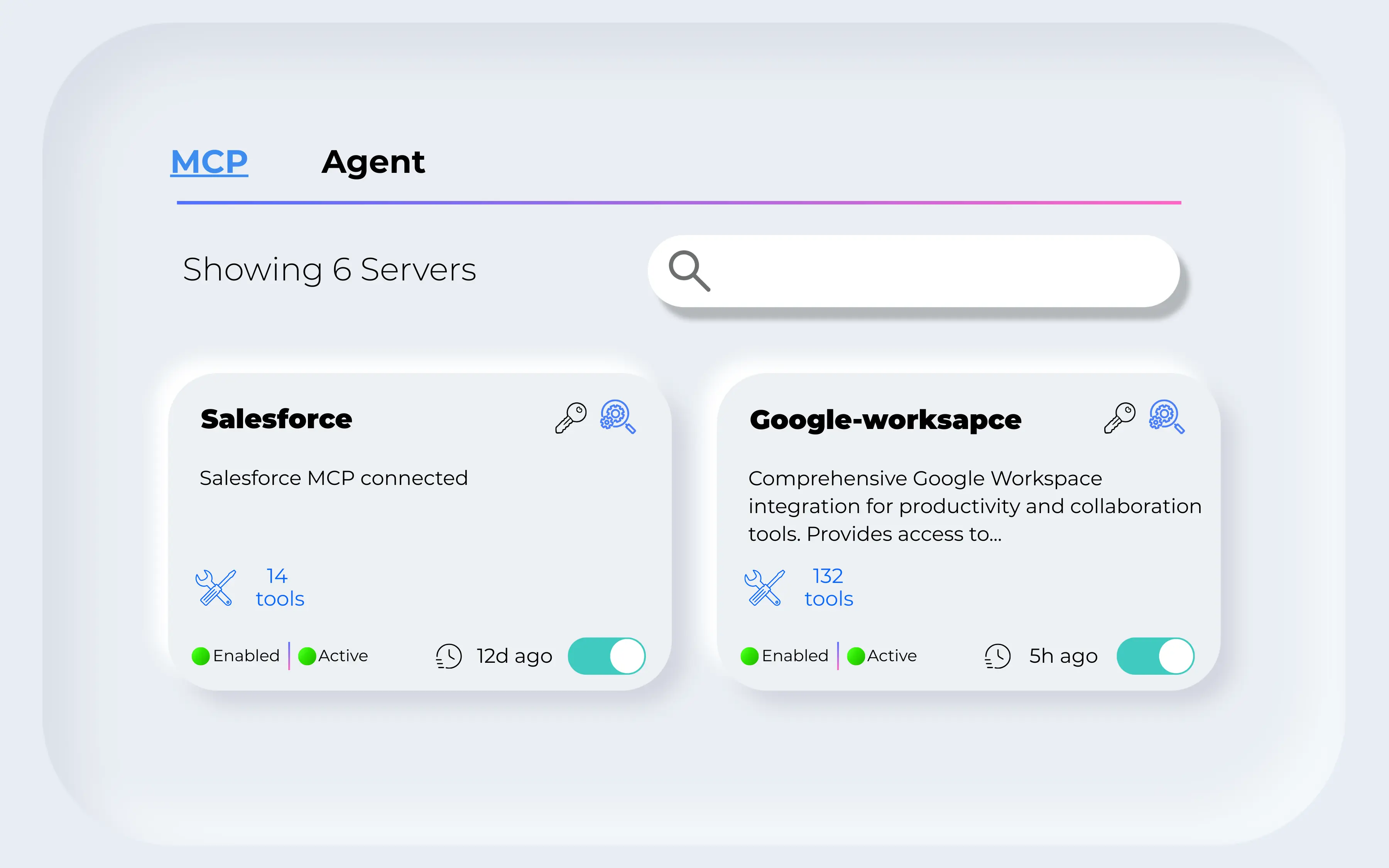
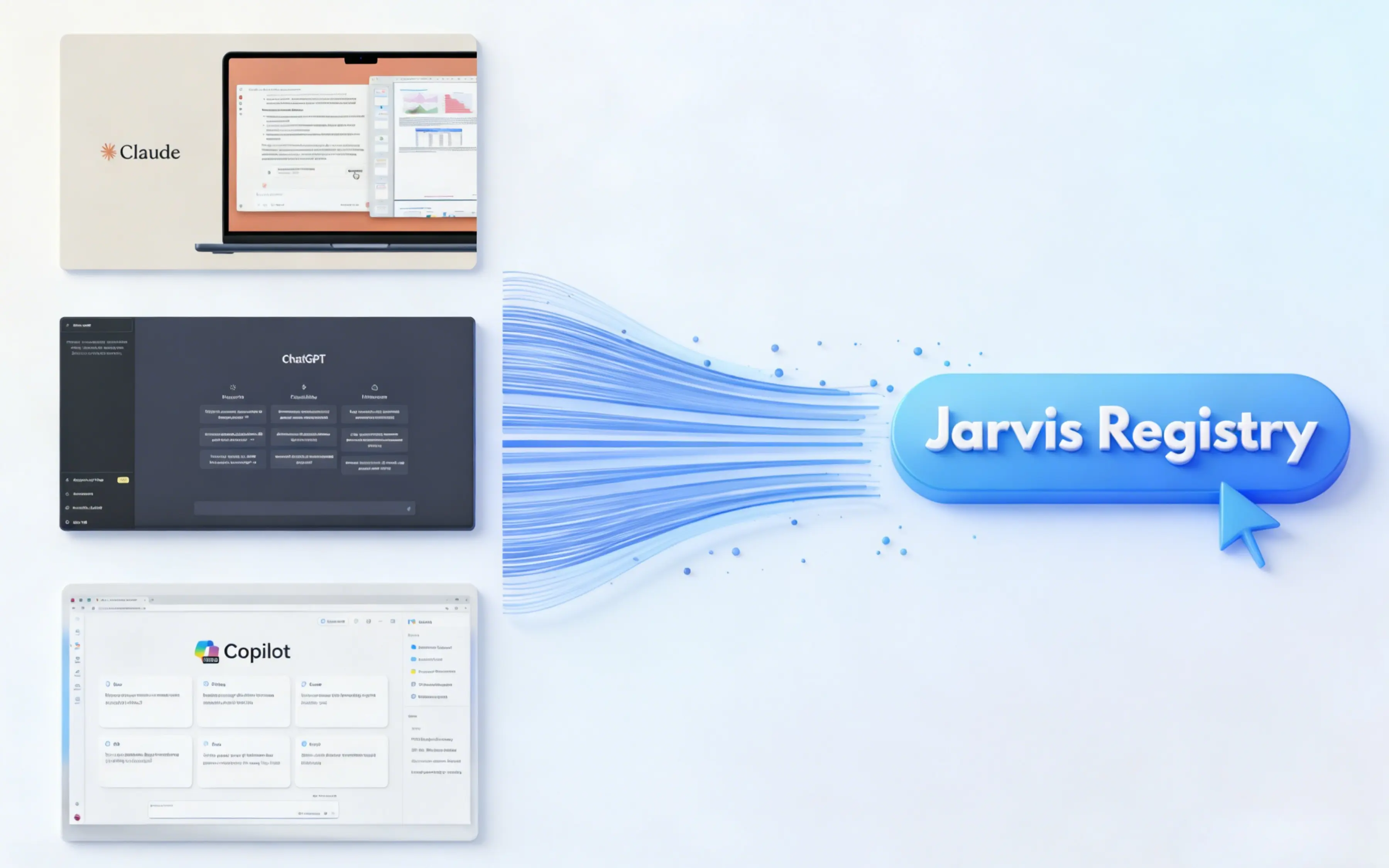
An agent gateway is the runtime endpoint through which AI copilots and applications invoke registered agents. Rather than each copilot connecting directly to each agent, all traffic flows through the gateway — which enforces authentication, applies RBAC and ACL policies, routes the request to the correct backend, and records the event for observability.

Jarvis Registry provides both the registry and the gateway in a single platform, deployed inside your own infrastructure.

The agent registry is the catalog — where agents are discovered, described, and governed. The agent gateway is the runtime — the single secure endpoint through which copilots invoke those agents.

Jarvis Registry provides both in one platform: a registry that maintains the catalog and policies, and a gateway endpoint that enforces them at request time. From a copilot perspective there is one URL; from an admin perspective there is one console to govern everything.

Federation

Multi-cloud agent integration

No. Federation works against your existing AgentCore and AI Foundry deployments. Agents continue to run where they already are — Jarvis Registry imports their metadata into the local catalog and proxies invocations through the gateway, applying RBAC and ACL policies on top of the existing deployment. There is no agent-side code change required.

Jarvis Registry connects to your AgentCore deployment using cross-account IAM role assumption. Once configured, Jarvis performs an on-demand sync to discover all agents in the target AgentCore workspace. Discovered agents appear in the registry catalog and are immediately subject to your RBAC and ACL governance policies. Copilots invoke them through the same Jarvis gateway endpoint as every native agent — the federation source is transparent to the client.

Jarvis Registry connects to Azure AI Foundry using your tenant credentials, scoped to the subscription and resource group you specify. Synced agents are imported into the local catalog and governed by the same identity and access policies as all other registered agents — RBAC scopes, per-user ACLs, and audit logging apply uniformly regardless of whether an agent runs in Azure, AWS, or on-premises.

Orchestration

Agentic workflows and pipelines

Jarvis Registry supports two distinct orchestration models.

Manual drag-and-drop pipeline: a visual canvas where you connect registered agents in sequence or parallel to define a deterministic workflow. This is best for compliance-sensitive processes where every step must be auditable and predictable.

LLM-driven orchestration: you define a curated pool of permitted agents and provide a task. An LLM reasons over the task, selects the appropriate agents from the pool, and sequences execution dynamically. The LLM operates only within the approved agent pool, so governance is maintained without constraining the model reasoning.

Both models share the same governance layer, observability pipeline, and security posture.

Yes. You can define a pipeline where certain stages are deterministic — a fixed agent sequence or a human approval gate — and others delegate to an LLM sub-orchestrator over a defined agent pool. This lets you enforce strict control at sensitive steps while giving the LLM flexibility over intermediate processing where determinism is less critical.

Security & access control

Security and access control

Every agent published to the registry passes through an automated security scan before it can be invoked.

The scan covers prompt injection patterns in system prompts and capability declarations, capability misuse risks where agents declare access to tools or data beyond their intended scope, and policy compliance against custom rules you define per environment.

The scan acts as a publish gate — an agent cannot be invoked until it passes. Re-scan triggers automatically whenever an agent card is updated, ensuring no previously approved agent can silently introduce a risk through an update.

Jarvis Registry integrates with your enterprise identity provider such as Azure EntraID, Okta, or Auth0 via OIDC and SAML.

Access is governed at two levels: RBAC scopes that control which agents a user or group can discover and invoke, and ACL policies that provide per-agent access control lists for specific users, teams, or service identities.

Both layers apply uniformly to native agents, AWS AgentCore-federated agents, and Azure AI Foundry-federated agents. A user only sees and can invoke what they are explicitly authorized for, regardless of where the agent runs.

No. Jarvis Registry is licensed, customer-hosted software that deploys into your own Kubernetes environment such as AWS EKS, Azure AKS, or GKE. All agent metadata, access control policies, audit logs, and invocation telemetry remain inside your infrastructure. There is no external data plane and no shared cloud service that receives your data.

Observability & compliance

Observability and compliance

The integrated OpenTelemetry collector instruments every layer of the agent gateway without requiring any changes to your agents.

It captures distributed traces from copilot request through gateway routing to agent response, invocation metrics such as latency, error rates, token usage, and throughput per agent, per user, and per team, workflow execution events for both manual and LLM-driven pipelines, and access decisions including denials for compliance reporting.

All telemetry exports via OTLP to any compatible backend, including Datadog, Grafana, Honeycomb, AWS CloudWatch, Azure Monitor, or self-hosted stacks like Jaeger and Prometheus.

Yes. Every agent invocation, workflow step, tool call, and access decision is logged. Audit logs are stored within your environment and can be integrated with your existing logging and SIEM tooling. This supports compliance requirements across regulated industries including finance, healthcare, and government.

Logs are retained inside the registry independently of any OTLP export destination, so compliance reporting is available even before you connect an observability backend.

Platform

Compatibility and deployment

Jarvis Registry works with any MCP-compatible AI client. This includes Claude Desktop, Claude Code, VS Code, Cursor, GitHub Copilot, Microsoft Copilot, Windsurf, Jarvis Chat, and ChatGPT. One registry, every client — no duplicate configuration required per tool or per team.

The two products are fully independent and can be used separately. Jarvis Registry is the agent gateway and catalog — it serves any MCP-compatible copilot. Jarvis Chat is a governed multi-LLM chat workspace for enterprise teams.

When used together they form a complete enterprise AI platform: Jarvis Chat connects to Jarvis Registry to discover and invoke agents, while Registry simultaneously serves Microsoft Copilot, Claude, VS Code, and any other client your teams use. Neither product requires the other.

Agent Gateway specifications

Federating agents across 2 clouds raises questions about credentials, redeploys, and whether a chain that crosses providers still produces 1 readable trace. The rows below answer each with a named standard or a count.

Federation, registration, routing, and telemetry specifications for the Agent Gateway.
SpecificationValue
Federated runtimes2 — AWS AgentCore and Azure AI Foundry
Agents redeployed0 — each agent stays in its home runtime
Catalog namespaces1 shared namespace across both clouds
Registration gate1 security scan per agent version, before the entry is invocable
Runtime scan cost0 ms per invocation — the check runs at registration
Agent credentialsPer-agent OAuth 2.0 (RFC 6749) client credentials
Cross-cloud exchangeOAuth 2.0 Token Exchange (RFC 8693)
Token formatJSON Web Token (RFC 7519)
Identity federationOpenID Connect Core 1.0 and SAML 2.0
Tool protocolModel Context Protocol (MCP) over JSON-RPC 2.0
Client coverage6 named MCP clients through 1 governed endpoint
A2A audit record4 fields per hop — invoking identity, target agent, tools called, policy version
Cross-cloud trace1 trace per chain regardless of which provider hosted each step
TelemetryOpenTelemetry OTLP collector, built in
Transport securityTLS 1.2 minimum, TLS 1.3 preferred (RFC 8446)
Denial responsesHTTP 401 unauthenticated, HTTP 403 policy denial
Zero-trust referenceNIST SP 800-207 (2020)
AI governance referenceNIST AI RMF 1.0 (2023)
Runtimes3 managed Kubernetes services — Amazon EKS, Azure AKS, Google GKE
Contract tiers3 standard tiers, USD 18,000–60,000, plus private offers
Customer rating5 out of 5 from 1 verified AWS Marketplace review

Watch a governed agent in a real workflow

An agent invoked through the gateway against a live support system, showing the routing and policy path the answers above describe.

Next-Level Zendesk: Smarter Support with Jarvis AI Integration · 4 min 51 sec

Agent Gateway at a glance

The Agent Gateway is the half of Jarvis Registry that registers, secures, and routes enterprise AI agents. It is built by ASCENDING, an AWS Advanced Tier Services Partner with the AWS Generative AI Competency. These 6 rows summarise the architecture decisions behind it.

Reference facts for the Jarvis Agent Gateway, covering federation, security scanning, routing, and telemetry.
ConcernHow the Agent Gateway handles it
FederationAWS AgentCore and Azure AI Foundry agents are registered where they already run — no redeploy and no second runtime.
Registration checksEvery agent is security-scanned at registration before it becomes invocable from any client.
RoutingContext-aware invocation routing selects the right agent version and target for each call.
Agent-to-agent callsA2A invocations carry their own OAuth client credentials, and permitted targets are declared per agent in ACL policy.
Client reachAny MCP-compatible client — Microsoft Copilot, Claude, VS Code, Cursor — invokes agents through one governed endpoint.
TelemetryA built-in OpenTelemetry collector records each hop, the policy version in force, and the resulting decision.

How to register your first agents

Because the gateway federates rather than migrates, existing cloud agents keep their runtime and release process. These 5 steps take a team from an empty catalog to a governed, observable agent integration.

  1. Deploy Jarvis Registry. Install into an existing Kubernetes cluster on Amazon EKS, Azure AKS, or Google GKE in your own account.
  2. Federate the clouds. Connect AWS AgentCore and Azure AI Foundry so their agents appear in one catalog without being redeployed.
  3. Scan and register. Register each agent and review the security scan result before the entry is exposed to any client.
  4. Declare the access policy. Set the ACL entry for each agent, including which other agents it may invoke in an A2A chain.
  5. Connect clients and watch the traces. Point copilots at the gateway, then use the OTEL output to confirm routing and policy behave as designed.

Governed agents in practice

Registration turns an ungoverned collection of cloud agents into a catalog with identity, policy, and an audit trail attached to every invocation.

Jarvis Agent Gateway applying governance policy to registered enterprise AI agents
Each agent carries its own policy entry, evaluated on every invocation.
Enterprise AI copilots invoking governed agents through the Jarvis Agent Gateway
One governed endpoint serves every MCP-compatible copilot in the organisation.

Related Jarvis resources

Agent federation spans two clouds and two gateways. These pages cover the neighbouring pieces in more detail.

Standards and references

The gateway is assembled from published protocols and vendor-documented runtimes rather than proprietary glue.

Still have questions?

Our team is happy to walk you through architecture, security, and pricing specific to your environment.