
Deployment boundary
Where do control-plane services run, and where does each model or tool request travel?
Scope comparison · Reviewed September 2026
Compare three enterprise MCP governance approaches by deployment boundary, registry scope, identity, runtime policy, agent controls, observability, and implementation ownership.
Compare product scope
Compare the same eight decision points across all three platforms, then use the proof checks below to evaluate each product against your environment.
| Decision area | Jarvis Registry | Obot | Gravitee |
|---|---|---|---|
| Primary scope | Customer-hosted MCP and agent governance across separate registry and gateway responsibilities. | Open-source AI control plane and MCP gateway for agents, tools, MCP servers, and Skills. | API-management-led agent platform spanning LLM, MCP, and A2A traffic. |
| Deployment approach | Runs in a customer-controlled environment, with documented AWS and Azure federation and ASCENDING implementation support. | Community and Enterprise editions can be self-hosted; Obot Cloud provides a hosted option. | Positioned as an extension to an existing Gravitee gateway and API estate; confirm the required edition and topology. |
| Registry and catalog | Catalogs MCP servers, tools, and agents, with distinct lifecycle controls for registered agents. | Provides a central registry for MCP servers and Skills, plus discovery of agents and shadow MCP usage. | Catalogs models, MCP servers, tools, skills, resources, prompts, and agents. |
| Identity and access | Documents Entra ID, OAuth and SAML integration, RBAC, and per-tool and per-agent access rules. | Documents SSO and OIDC plus role and user-group policies for agent and tool actions. | Documents fine-grained, catalog-aware authorization and identities for different agent actors. |
| Runtime governance | Uses separate MCP Gateway and Agent Gateway layers for tool calls and agent-to-agent access. | Applies policies across agents, MCP servers, command-line tools, and tool calls through its control plane. | Applies governance through LLM, MCP, and A2A proxies in the same platform. |
| Observability and audit | Documents tool-call and agent-hop logs, OpenTelemetry output, and forwarding to existing SIEM tooling. | Documents tool-call and LLM-request logs, dashboards, and exportable audit data. | Documents end-to-end lineage, audit trails, usage controls, performance, and cost visibility. |
| Operating model | Licensed software paired with architecture, integration, and rollout support from ASCENDING. | Inspect and operate the open-source code, use the hosted service, or purchase Enterprise support. | Extends a gateway-led API program into AI traffic; confirm packaging and services with Gravitee. |
| Best starting fit | Customer-hosted, cross-cloud governance and hands-on implementation are central requirements. | Open-source code access and self-operation are central requirements. | MCP and agent governance should extend an established API-management strategy. |
Sources: Jarvis Registry, Obot, and Gravitee AI Agent Management.
Need a broader shortlist? Use the enterprise MCP gateway comparison framework.
Run the same proof test
Where do control-plane services run, and where does each model or tool request travel?
Does the catalog cover MCP servers only, or also tools, agents, skills, owners, versions, and approval state?
Which users, workloads, agents, and downstream services retain identity across the full call chain?
Can policy be applied per team, server, tool, environment, and agent at invocation time?
How are approvals, updates, deprecations, rollbacks, and revoked access propagated?
Can your team trace identity, policy decisions, tool calls, latency, and errors in its existing monitoring stack?
Who owns integration, policy design, migration, upgrades, incident response, and ongoing support?
Which edition, support terms, procurement path, and rollout scope match the first production workload?
Where Jarvis is strongest
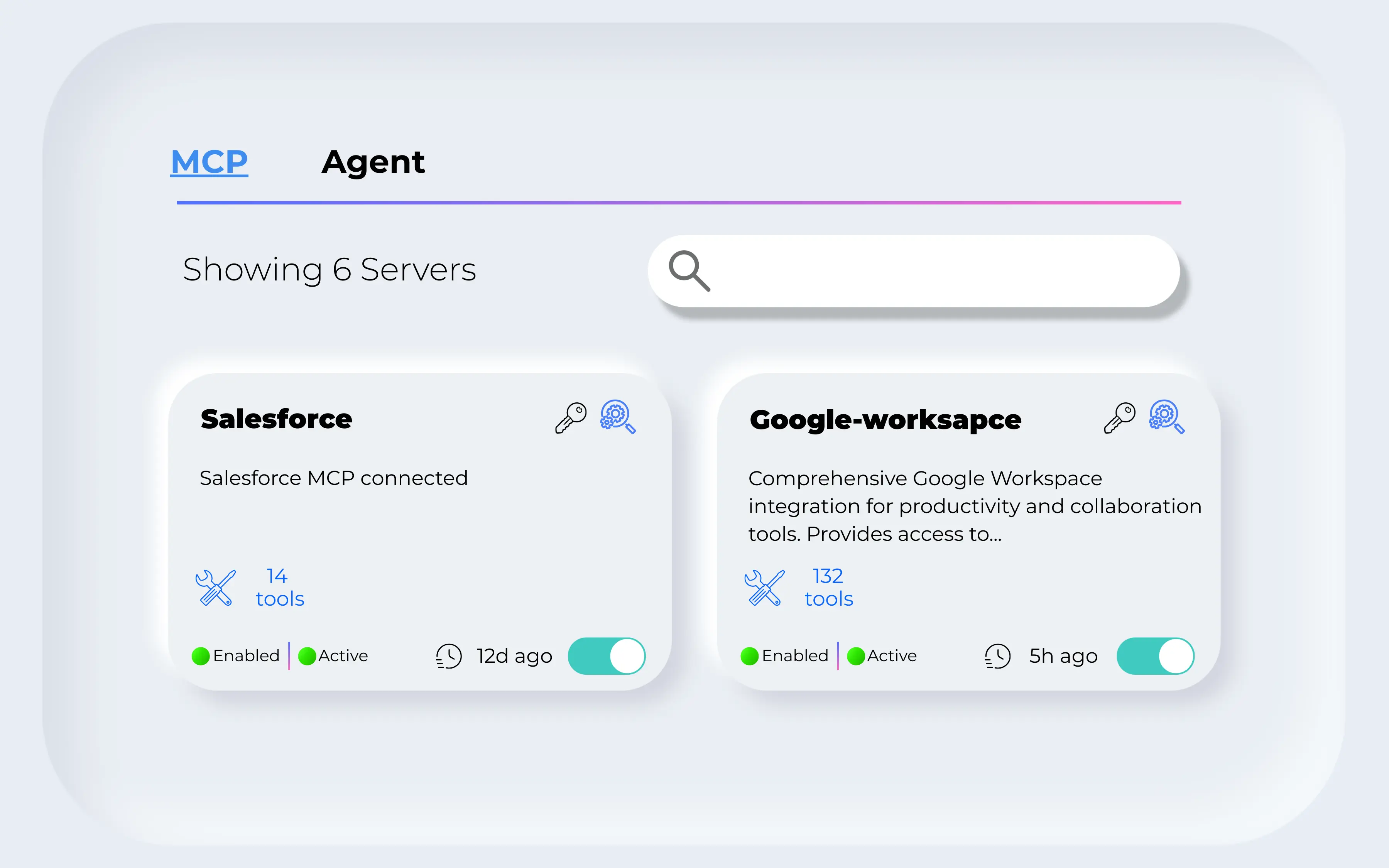
Jarvis separates three jobs that buyers often blend together: the MCP Gateway governs tool calls, the Agent Gateway governs agent-to-agent access, and the Agent Registry manages ownership and lifecycle.
That architecture is most relevant when an organization wants one governed entry point across AWS and Azure workloads and expects an implementation partner to help connect identity, policy, telemetry, and the first production use case.
The Jarvis advantage
Obot emphasizes open-source self-operation. Gravitee extends API management into AI traffic. Jarvis combines a customer-hosted control plane, distinct registry and gateway responsibilities, AWS and Azure federation, and ASCENDING implementation support.
That makes Jarvis the stronger starting point when the goal is not only to catalog MCP servers, but to take governed multi-cloud agents into production with identity, policy, lifecycle, and observability connected from the start.
Architecture proof
Questions buyers ask
Jarvis centers on customer-hosted MCP and agent governance with ASCENDING implementation support across AWS and Azure. Obot publicly centers open-source, self-hosted control of MCP servers and agents. Gravitee centers AI agent management within a broader API management platform. Buyers should validate the same deployment, identity, policy, lifecycle, and observability scenarios with each vendor.
Jarvis Registry is the strongest fit for enterprises that need customer-hosted MCP and agent governance across AWS and Azure, with identity, runtime policy, lifecycle controls, observability, and implementation support connected in one rollout.
Start with the product that can prove your required control boundary across the clouds, identities, tools, and agents you already operate. Jarvis is designed for organizations evaluating a customer-hosted governance layer and implementation support across AWS and Azure, but the final choice should follow a scenario-based proof of concept.
Ask each vendor to register or discover a real server, restrict one tool for one identity, revoke access, trace the call and policy decision, show how a version is deprecated, and document where every request and credential travels. Use the same scenario for all three products.
Test the fit
The evaluation should prove the data path and policy behavior, not only show a feature list.